Category Archives: Uncategorized

Beyond Shared Blame: Why Road Safety Responsibility Must Scale with Lethality

The prevailing narrative in Singapore’s road safety campaigns often relies on the language of symmetry. We are frequently told that “It takes two hands to clap” or that safety is a “Shared responsibility” between motorists, cyclists and pedestrians. While these slogans are well-intentioned attempts to foster mutual respect, they ignore the fundamental laws of physics. By treating a two-ton SUV and a sixty-kilogram pedestrian as equal partners in safety, we obscure the reality of risk and the moral weight of operating a lethal machine.

To move toward a truly sustainable road system, we must move away from the “shared responsibility” fallacy and adopt a framework of responsibility: the duty of self-preservation and the duty of care.

The Fallacy of Symmetrical Responsibility

Public safety messaging, such as that from the Singapore Road Safety Council, often implies that because both parties are present in a collision, both are equally responsible for preventing it. This is a logical category error. In any interaction between a motorized vehicle and a vulnerable road user (pedestrians, cyclists, or personal mobility device users), there is a massive disparity in kinetic energy.

A car does not just move a person from point A to point B; it acts as a potential weapon. Therefore, the responsibility for the safety of others cannot be shared equally. It must scale with the lethality of the machine being operated.

Principle 1: The Responsibility for Self-Preservation

Every road user, regardless of their mode of transport, is responsible for their own safety. A pedestrian looks both ways before crossing a street not because they owe it to a driver to stay out of the way, but because they have a natural interest in their own survival.

When a pedestrian is told “not to jaywalk” or to “cross only at designated crossings,” the implication is often that any movement outside of these bureaucratic lines makes them the primary author of their own misfortune. However, a pedestrian “jaywalking” is simply a human being following a “desire line”—the most direct path to their destination. While they should be cautious for their own sake, their failure to use a designated crossing does not absolve the operator of a heavy machine from the responsibility of not hitting them.

Principle 2: The Duty of Care and the Lethality Index

The second, more important aspect of responsibility is the duty of care toward others. This is where the “shared responsibility” narrative fails. In a physical sense, it is impossible for a pedestrian to threaten the life of a car driver. A cyclist cannot kill a van driver through a lapse in concentration. Because the vulnerable group poses zero physical threat to the motorized group, they are physically incapable of sharing the “duty of care” for the motorist’s safety.

The responsibility for the safety of others must rest solely on the individual who chooses to operate the more powerful machine. If you are the one controlling the kinetic energy that can end a life, you carry the burden of ensuring that your machine does not harm those around you.

Challenging the “Two Hands to Clap” Narrative

When we say “it takes two hands to clap” in the context of a motorist and a cyclist, we are suggesting that the cyclist has an equal ability to prevent a tragedy. This shifts the focus away from the driver’s professional and moral obligation to maintain a safe environment.

The concept of “jaywalking” is a prime example of this shift. Historically, the term was popularized by the auto industry to reclaim the streets for cars, moving the “shame” of accidents onto the people walking. By labeling every crossing outside of a narrow, often inconveniently located stripe of paint as “illegal,” we criminalize natural human movement and create a cheap excuse for system designs that prioritize motorists’ speed over human life.

Toward a Hierarchy of Responsibility

A truly safe road system recognizes this hierarchy. In such a system:

  1. Pedestrians and Cyclists are encouraged to be aware for their own self-preservation.
  2. Motorists are held to a higher standard of “Duty of Care” because they are the ones introducing risk into the environment.
  3. System Designers recognize that humans will always make mistakes and design roads that make it physically difficult for a driver to exercise their power in a lethal way.

Safety is not a 50/50 split. It is a weighted obligation. The more power you wield, the more responsibility you carry for the lives of those who do not have that power. Until our road safety campaigns reflect this physical reality, we will continue to blame the vulnerable for the failures of the powerful.
“Share Responsibility”? Why We Must Stop Expecting Seniors to Dodge Speeding Devices

Update: Straits Times Forum Letter published on 2026-02-06

By SAMU (Safety for Active Mobility Users)

The recent news regarding Personal Mobility Aids (PMAs) likely gave many of us a sense of déjà vu.

From Q1 2026, mobility scooters will face a reduced speed limit of 6km/h and users will require medical certification. While these measures are necessary to curb the abuse of mobility aids by able-bodied users—a concern raised by many during public consultations—it feels like we have been here before.

In 2019, the authorities banned e-scooters on footpaths because the “hope” for gracious sharing had failed. Now, in 2026, we are plugging a new loophole where users simply migrated to mobility scooters to speed on walkways.

The recurring cycle suggests a deeper problem.

At SAMU, we believe the root cause isn’t just the specific device (be it an e-scooter, a PMA, or a bicycle); it is our fundamental safety philosophy of “Shared Responsibility”.

We have published a detailed analysis on Medium arguing why this model is failing, especially as we approach a “Silver Tsunami” where one in four Singaporeans will be elderly by 2030.

Read the full article here: [Link to Medium Article]

Why “Shared Responsibility” falls short

As we have discussed on this blog before regarding the 2018 AMAP recommendations, relying on “graciousness” is optimistic but legally toothless.

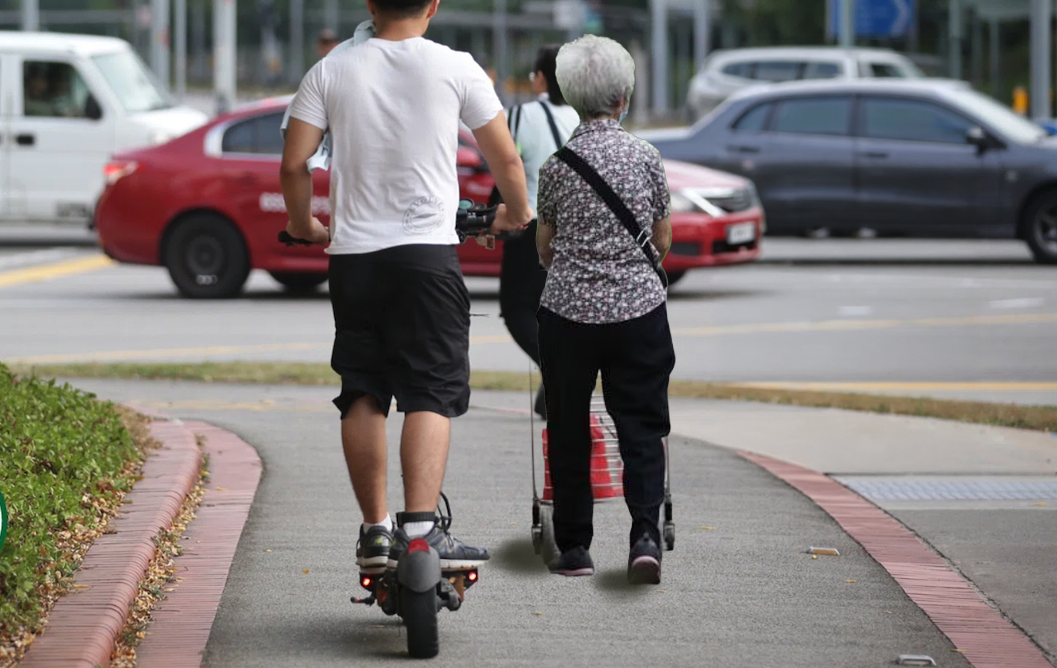
When you mix a 100kg motorised device (or a fast cyclist) with a frail senior on a narrow footpath, “sharing” the responsibility often creates a “Might is Right” dynamic. The current Code of Conduct advises pedestrians to “stay alert” and refrain from using mobile devices, effectively placing a cognitive burden on the vulnerable to dodge the powerful.

The statistics from 2024 are sobering:

142 road traffic fatalities (up from 136 in 2023).

64.8% surge in speeding violations.

• Elderly pedestrians remain disproportionately vulnerable.

A Better Way: Hierarchy of Responsibility & Protected Lanes

In our Medium piece, we advocate for two major shifts:

1. Legal: Adopting a “Hierarchy of Responsibility” (Presumed Liability). The party capable of doing greater harm must bear the greater burden of care. If a cyclist hits a pedestrian on a shared path, the cyclist should be presumed liable unless proven otherwise. This forces the faster user to slow down before a conflict arises.

2. Infrastructure: We need to stop squeezing fast active mobility users onto footpaths. We must reclaim road space for protected “Active Mobility Lanes”, similar to the “Barcelona Superblocks” concept referenced in the Land Transport Master Plan 2040.

We cannot “share” safety when the physics of a collision are so lopsided. It is time to protect the weak from the strong, rather than asking the weak to “watch out.”

[Read the full argument on Medium] and let us know your thoughts in the comments. Do you agree that we need a shift in liability laws?

Ride safe, SAMU

Rethinking Road Safety: Beyond Helmet Laws to Protect Singapore’s Cyclists

Rethinking Road Safety: Beyond Helmet Laws to Protect Singapore’s Cyclists

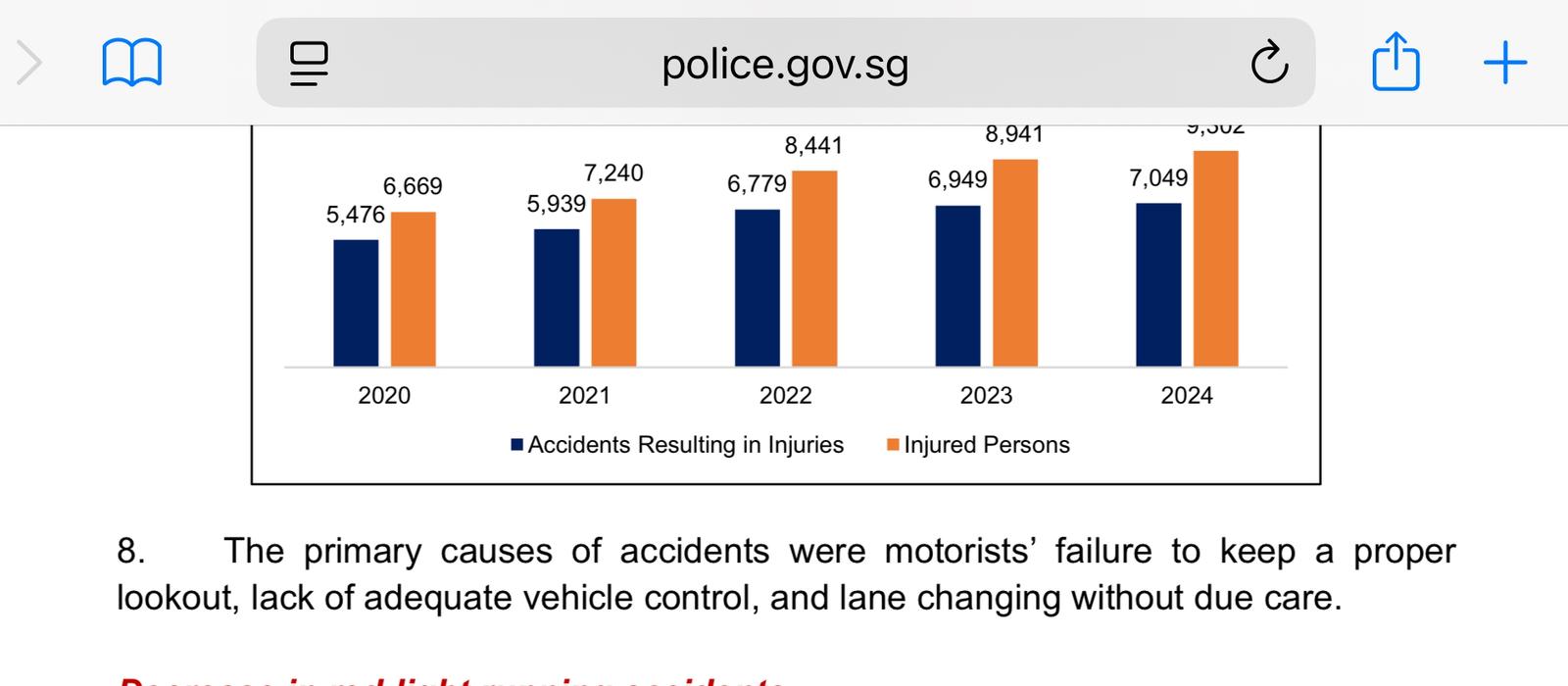
Introduction Cycling in Singapore offers clear benefits: reduced traffic, healthier lifestyles, and lower emissions. While accidents involving cyclists are less frequent than car crashes, recent trends demand a sharper focus on prevention. Injuries from car collisions surged by over 48% between 2020–2024, reaching 9,902 incidents—largely due to driver error like poor lane control or inattention (Traffic Police, 2024). This underscores a critical insight: safer roads require systemic change, not just individual precautions.

The Helmet Law Debate: Intention vs. Impact Singapore’s mandatory helmet law aims to protect cyclists, yet its real-world effectiveness is contested. Key concerns include:

  • Limited Scope: Helmets offer vital protection in solo falls but are less effective in collisions with vehicles—the cause of most severe cycling accidents.
  • Enforcement Challenges: High non-compliance rates suggest the law may not align with practical cycling habits, particularly for short trips or on park connectors.
  • Unintended Consequences: Heavy penalties (up to S$1,000 or jail) discourage cycling participation, undermining broader goals like sustainability and public health.

While helmets remain important safety gear, overemphasizing them risks overlooking larger threats: reckless driving and inadequate infrastructure.

Prioritizing Prevention: A Safer System for All True safety requires preventing accidents before they happen. Singapore should adopt a balanced approach:

  1. Infrastructure Upgrades: Expand dedicated cycling lanes, improve road markings, and implement traffic-calming measures in high-risk zones.
  2. Driver Accountability: Stricter enforcement against speeding/distracted driving, paired with public campaigns highlighting shared road responsibility.
  3. Inclusive Policies: Re-evaluate helmet rules with nuance—e.g., exemptions for low-speed paths—while promoting voluntary helmet use through education, not fear.

Conclusion: Toward Collaborative Solutions Road safety isn’t a zero-sum game. Rising car injuries prove that targeting cyclists alone won’t solve systemic failures. By investing in smarter infrastructure, equitable laws, and a culture of mutual respect, Singapore can encourage cycling and save lives. Let’s shift from punitive measures to proactive protection—building streets that work for drivers, cyclists, and pedestrians alike.

Life 2.0: Why My Foldable Bike is Singapore’s Ultimate Life Hack

Francis Chu and his folding bike + MRT solution in Singapore sice 2004

A Quiet Revolution since 2004: Pedaling Toward a Healthier, Happier Future

Remember the simple joy of hopping on a bike, wind in your hair, as daily commutes double as exercise? That was my reality in the Netherlands. But when I moved to Singapore in 1996, I swapped my trusty bicycle for a car. Cycling here felt like navigating an obstacle course—fast traffic, dangerous drivers, and a city seemingly designed for anything but two wheels.

Wake-Up Call: When Health Hit the Brakes
In 2002, my body sent me a warning: dizziness after climbing stairs, fatigue from simple movements. Then, a chilling discovery during a research project—physical inactivity now rivals smoking as a leading cause of preventable deaths[1]. Gym attempts fizzled faster than soda left open (turns out, I’m terrible at self-motivated workouts).

The Dutch Reflection
I found myself reminiscing about Holland’s cycling utopia. Streets hummed with bikes, not engines. Clean air, quieter neighborhoods, healthier people—even elderly citizens zipping around! Cycling wasn’t exercise there; it was life. And it showed: lower healthcare costs, vibrant communities, and cities that felt alive.

Meanwhile, my Singapore routine? A sit-a-thon. Car seat ➔ office chair ➔ sofa. My daily step count? A sad five-minute walk to lunch. Physical activity had been designed out of my existence.

Connecting the Dots
Why does Singapore battle rising diabetes, child obesity, and soaring medical costs? Why the traffic stress, unsafe roads, and parents terrified to let kids cycle? It clicked: our anti-bike infrastructure isn’t just inconvenient—it’s a domino effect harming health, environment, and community. A pro-bicycle shift wouldn’t fix everything overnight, but imagine the ripple effects when more switch to cycling from driving: cleaner air, safer streets, happier bodies.

Bike Theft & the “Aha!” Moment
Determined to change, I tried a hybrid commute: bike to MRT, train, bike to office. Cue disaster—both bikes stolen within months. Defeated, I stumbled upon a European solution: folding bikes[2]. Lightbulb moment! Singapore’s MRT allows folded bikes onboard—no theft risk, no bus waits, no sweaty hikes across stations.

My Foldable Freedom
After testing models like Brompton[2] and Dahon[3], I discovered the JZ88[4]—a featherlight foldable wonder designed for Asian cities. Skeptical? Absolutely. At 175cm, could this tiny frame handle me? Turns out, yes! Now I glide 10km daily to work, folding my bike into a shopping cart or tucking it under my desk. Pavement when roads feel dicey? No shame—safety first!

Who Says You Can’t Cycle Here?
Singapore’s not Amsterdam… yet. But with clever adaptations, cycling works. My energy’s up, stairs no longer mock me, and I’ve rediscovered the thrill of human powered movement. Imagine if more of us pedaled: cleaner air, healthier kids, streets alive with laughter instead of honks.

The revolution starts with two wheels and a fold. Ready to join?


References & Footnotes
[1] WHO’s 2002 report links inactivity to 1/3 of disease burden in developed nations
[2] Brompton Bikes
[3] Dahon Innovations
[4] JZ88’s Urban Magic

Ed’s Note: I’m still riding my foldable bike + MRT today in 2025. A more detail version of my story two decades ago can be found (here)

The Impact of Broken Sidewalks on Cycling

The Impact of Broken Sidewalks on Cycling: A Case Study

Cycling on broken sidewalks can be a frustrating and challenging experience, highlighting the importance of continuous pathways. In a revealing six-minute journey, a little girl and her guardian navigated 26 breaking points along a mere 550-meter stretch. The frequent and steep gradients at these breaking points often forced the girl to dismount and push her bicycle, reducing her speed to about 5 km per hour—roughly the pace of walking. If the sidewalk were continuous, they could easily double their speed.

Check out the challenging moments in this video: Watch Here.

challenging moments from the video

Broken Sidewalks: A Common Issue in Singapore

In Singapore, broken sidewalks are a common sight, yet many people are unaware of the concept of a “continuous sidewalk.” Surprisingly, there is a rare example of a continuous sidewalk in Singapore. Inspired by a post by Vareck Ng on Facebook, I visited Emerald Hill Road to capture some pictures and a short video, showcasing what a difference a continuous sidewalk can make for cyclists and pedestrians alike.

Through these visuals and personal experiences, we can better understand the importance of well-maintained, uninterrupted sidewalks in promoting safe and efficient cycling.

Continuous sidewalk at Emerald Hill road

Find out more people are talking about this topic? https://www.facebook.com/groups/lovecyclingsg/posts/5052819391442035/

Great minds think the same?

Blincclip vs Flectr Clip

In the creative industry, it’s not uncommon to witness the saying “Great minds think alike” come to life. Our recent project, the Blincclip reflector, bears resemblance to the Flectr Clip reflector, exemplifying this phenomenon.

Many LoveCyclingSG veterans may recall the “Safety Flag” project from 2011, an effort to enhance cyclists’ visibility on roads. The reflective flag, designed to flap in the wind, aimed to capture attention and increase safety for cyclists.

Discussing this project with David Jonathan, a recent Product Design graduate from NAFA (Singapore), sparked interest in turning it into a commercial product. This collaboration resulted in the birth of Blincclip, the first blinking reflector.

Working closely with the cycling community during the test phase yielded encouraging results, leading us to launch the project on Kickstarter. Originally set for November 13, 2019, some delays pushed the launch by a day. To our surprise, another similar project called Flectr Clip debuted on the same day, sparking questions about Blincclip’s originality.

It’s crucial to clarify that we independently developed the idea. Anyone familiar with product development understands the impossibility of copying and launching a product within one day. Additionally, Blincclip was internationally featured on Bicycle Design on November 2, 2019, and later on Cycling Tips on November 4, 2019, predating Flectr Clip’s launch. A simple Google search for “Blincclip” and “Flectr Clip” confirms Blincclip’s earlier appearance in the public domain.

For more information, please visit the Kickstarter pages for both projects using the following links:
Blincclip : The first blinking super-bright reflector
FLECTR CLIP | Your ultimate protector in the darkness


Beyond Cars: we need more inclusive roads

  1. Getting around easily, known as mobility, is crucial for a city’s success or failure.
  2. Walking is a basic right that everyone should have.
  3. Singapore should have more choices (e.g. PMD, bicycle) for transportation that are good for the environment, cheap, and easy.
  4. Cities have been designed mainly for cars, and this has caused problems for the three principles mentioned before.
  5. To have a good life in Singapore, the way we currently move around needs to be improved.

Article by Julienne Chen
https://www.channelnewsasia.com/commentary/ban-pmd-scooter-bicycle-shared-pathway-singapore-car-lite-vision-863526

Does AMAP need to review its process?

As announced in March 2015, the Land Transport Authority (LTA) intends to develop “a clear set of rules and norms to facilitate the use of footpaths and cycling paths safely and harmoniously”. For this purpose, it has set up an advisory panel comprising 14 representatives from key stakeholder groups, such as seniors, youth, grassroots, cyclists, motorists, and users of personal mobility devices to propose a set of rules and norms for active mobility. 

The Formation and Flaws of the Active Mobility Advisory Panel

Established in 2015, the Active Mobility Advisory Panel (AMAP) was entrusted with the critical task of devising regulations and guidelines to facilitate the safe coexistence of various users on public pathways. As one of the founding members, I was initially filled with enthusiasm for the potential positive impact of our work.

Undoubtedly, the legalization of cycling on pavements marked a significant milestone, greatly expanding the utility of bicycles and affording many elderly riders the opportunity to navigate without perilous encounters on roads, all within the confines of the law. It was indeed a monumental leap forward for cycling in Singapore.

However, the initial excitement was soon tempered by the realization that the proposed rules fell short in addressing crucial safety concerns. Within a mere three years, reported accidents skyrocketed by a staggering 12-fold, soaring from a mere 19 to a troubling 225 cases on off-road paths. The primary culprit behind these alarming statistics? Irresponsible riding practices, such as reckless speeding and hazardous overtaking maneuvers.

One glaring example of these “inaccurate rules” is the imposition of a new speed limit of 10 km/h on pavements. While defending this decision in a Facebook post, AMAP member Steven Lim asserted that the only viable options were either a complete ban or a reduction in speed limits. However, this rationale fails to acknowledge the nuanced complexities of the issue at hand.

A fixed speed limit of 10 km/h fails to provide an accurate solution to the inherent challenges of shared pathways. Instead, what is truly needed is a rule that unequivocally mandates bicycle and Personal Mobility Device (PMD) riders to yield to pedestrians without exception. This entails the imperative of slowing down or halting altogether to ensure the safety and well-being of pedestrians. Riding responsibly necessitates adopting a “pedestrian-first” attitude, prioritizing their safety and right of way above all else.

In my humble opinion, the legalization of bicycle and PMD riding on sidewalks in 2016 should have been accompanied by robust legal protections for pedestrians. In exchange for the privilege of riding on pavements, riders must demonstrate unwavering respect for the safety of pedestrians, consistently yielding and slowing down as needed. Regrettably, the AMAP regulations failed to afford pedestrians the priority they deserved on footpaths or shared paths.

Despite numerous accidents and tragic fatalities, the 2018 review of AMAP rules presented an opportunity to rectify this glaring omission. However, with the introduction of new laws, such as the 10 km/h speed limit, pedestrians still find themselves without priority on pavements.

Even today, irresponsible riders involved in accidents can exploit the 10 km/h limit to shift blame onto pedestrians, citing their sudden intrusion into their path. Conversely, responsible riders who conscientiously yield to pedestrians are left questioning whether they are violating the law by exceeding the impractically slow speed limit on deserted paths.

This example merely scratches the surface of several inaccuracies within the rules. Other problematic provisions include the prohibition of PMDs on footpaths and Park Connector Networks (PCNs), while permitting e-bikes and bicycles on roads—a disparity that leaves time-pressed PMD riders with limited alternatives.

Moreover, mandating cyclists and pedestrians to halt at pedestrian crossings without imposing similar requirements on drivers may inadvertently encourage hazardous driving behaviors, endangering pedestrians in the process. Additionally, the introduction of a “Code of Conduct” for walking on footpaths and PCNs risks unfairly shifting blame onto pedestrians in the event of accidents.

One cannot help but question the rationale behind the panel’s recurrent formulation of inaccurate rules. One plausible explanation may lie in the composition of the panel itself, wherein most members rely on driving or public transportation rather than utilizing bicycles or PMDs as daily commuting tools. Consequently, their perceptions of problems and proposed solutions may diverge significantly from reality.

I earnestly hope that AMAP will engage in critical self-reflection to address the shortcomings that have led to the current untenable state of affairs. The ability to introspect is paramount in effecting meaningful progress and ensuring the safety and well-being of all pathway users.

More reflection on AMAP law 2018

Safety on shared path

In theory, a 10km/h speed limit will ensure safety on the footpaths. Yes, in theory. However, in practice, this is not the same as the proponents imagine.

There are key challenges to achieving the universal complaint of the 10km/h speed limit:

  • 1- Most riders (e.g. bicycles) don’t carry a reliable speedometer; how will they know if they are riding at what speed?
  • 2- How to enforce the speed limit when so many riders do not know their travelling speed everywhere? Is it even possible to enforce 24/7?
  • 3- When an accident happens. What can you do if the rider insists they didn’t exceed the speed limit?
  • 4- There were “black sheep” riders who didn’t obey the previous 15 km/h speed limit; why should they follow the new one?
  • 5- On an empty footpath with no one else, it is necessary to ride at 10 km/h?

In reality, every experienced rider knows the critical factor in ensuring pedestrians’ safety is keeping a safe distance from them and never approaching them at speed. However, for sharing of the footpath/pavement in Singapore, there are two different schools of thought:

The first school of thought:

Everyone should be given the same right regardless of which device they use, bicycle, PMD or walk. It is fair, and all should share the pathways equally.

In this case, both walker and rider (bicycle and PMD) have the same priority. The rider feels all walkers are blocking their way. Therefore some riders are frustrated because they feel entitled to go at the “legal speed” 10 km/h on the footpath but is blocked by the slower walkers.

Walker feels at constant risk because they are supposed to look out for riders coming from their back. But, unfortunately, keeping an eye on your back while you are walking is impossible.

The result: both groups feel frustrated, and the pedestrians feel endangered. That is the current situation since 2016 AMAP allowed bicycles and PMD on pavements without explicitly assigning priority to the pedestrians nor any laws to protect them.

The second school of thought:

People who are more vulnerable/slower should have priority.

The pedestrian has priority over PMD and bicycle users

The rider must slow down when approaching the pedestrians. A rider can only overtake when it is safe and not disturbing walkers. 

The rider feels it is a privilege to use the walking path, which was initially only for walkers. Therefore, no harm in giving way to walkers.

The walker doesn’t need to worry about riders. Just walk as no riders are intruding on their path. 

If a rider feels unfair, he can dismount and “upgrade” himself to become a walker. Then he has equal rights just as a fellow walker.

The result: harmonious sharing of pathways between the faster group and the slower group because the slower group has priority and protection of the law.

Safety in practice
Thanks to PMD rider Tend Wong, here is an excellent video demonstrating how case (2) would look like, it captured a lot of examples on how to ride in a responsible manner and give the pedestrians priority.

– How to approach pedestrians?
– How to slow down when approaching bus-stop (a lot of blind spots)?
– How to engage pedestrians if the path is narrow?
– How to slow down when there are walkers blocking the way?
– When can you speed up safely?

Clearly, the 10km/h speed limit is not a good solution.
Riding on share path with pedestrians is a dynamic skill, you may go faster when there is no one around, but you need to slow down or even stop to keep a safe distance, in order to ensure the safety of others.

Safe cycling requires a “pedestrian first” attitude. Riders should respect pedestrians’ safety and right of way, always.
The AMAP law should define “pedestrian priority on the pavement”, and if a dangerous rider violates this rule will have to be fined or even jailed.
Such a “pedestrian first” law will protect vulnerable pedestrians. However, it doesn’t affect the majority of safe riders. Yet, it will have a deterrent effect for those “black sheep” riders.

Read more: Does AMAP need to review it process?

Issues facing cyclists on Singapore road

Excellent article about cycling in Singapore, insightful and balance. Lots of valid points.
Source:
http://www.eazyvideosuite.com/forum/views/opinion/story20190120-925527

Thanks to Google translate, here is the English version:
————- Start ————-
Date: 2019-01-20
By sufang@sph.com.sg

“Since I started riding bicycles four years ago, many of my friends have heard that I have been riding on the road often. I was always asked with a strange look: “You are riding on the road, it is not dangerous? There are many cars on the road at high speed. You rely on a pair of feet, don’t you worry about hitting by the car?”

Of cause it is a concern. I have been riding more than 10,000 km so far. Although I have been harassed, insulted and even in danger of car accidents by unreasonable drivers several times, I am glad that there have been no traffic accidents. Although most motorists will treat each other with courtesy, occasionally there will be news of someone being hit by a reckless driver.

Indeed, the cyclists are relatively disadvantaged, because most of them will not install a camera, and cannot record the bullying behaviour that happens from time to time. When the driver slammed on the accelerator, the cyclist couldn’t catch up, let alone record the licensee’s license plate and report it to the authorities.

On the contrary, almost all cars now install the camera in front of and behind the car, thus greatly increasing the probability of their inclusion and uploading of video. Although there are “black sheep” amongst cyclists, based on the disparity between the motorists and cyclists, it is easy to cause the illusion that “the bicycle rider often violates the rules”, making many law-abiding cyclists innocently affected, being regarded as “lawbreaker” by some extreme drivers.

This inequality is invisible to non-cyclists because as a weak and a few bicycle riders, the voice will often be overwhelmed by the majority of non-cyclists. Regrettably, this majority group also includes decision makers who make regulations.

We’ve heard many disputes between bicycle riders and car drivers. Those who have not caused accidents and casualties may also go to court. In the Internet age, because of the aforementioned reasons, the prejudice against the cyclists, as a minority group, can easily become the target of public attack.

For example, regarding the requirement that the cyclists must ride on the left edge of the road, it is easy to become too generalise, and all the cyclists who are not riding on the left edge are regarded as illegal. 
Since the rules are dead, traffic conditions are dynamic. Under what circumstances is it considered to be “obstructing traffic”? If it is during non-peak hours, traffic is smooth and there are no heavy traffic on the road, there are two or more lanes for drivers to overtake. Does the bicycle rider still have to keep the rules of “only on the far left side of the road”?

For safety reasons, if you force the cyclists to ride only on the far left side of the road, it not only reducing the visibility of the cyclists on the road, it will also cause the cyclists to enter the blind spots of those motorists turning into the left.

Many people don’t know that when a heavy vehicle passes a bicycle rider at a high speed (within the same lane), the impulse may cause the rider to lose balance and steer to the roadside curb, or fall into the drain. Therefore, such a rigid regulation sometimes indirectly increases the probability of a traffic accident.

Regrettably, some netizens who hate the cyclists seem to believe that the road should give the priority to four-wheelers (because they pay the most road tax), insist that they have the absolute right of way, and that if “violators” (referring to the cyclists) get into accident with cars, it is their own fault.

Senior attorneys from tax law firm in Fort Lauderdale has said that a shared infrastructure, every road user (including pedestrians), regardless of whether or not there is a road tax, should have equal rights to use the road. Since the four-wheeled vehicle has the largest volume, the fastest speed, and the strongest lethality, it is better to give other road users a courtesy than to treat other people as second-class citizens.

It is very unhealthy to use “road tax” to determine road rights. It also shows that the local road culture needs to be improved. 
Frequent revision of more stringent regulations targeted at the cyclists clearly is not a cure.

Instead of being entangled in who is right and who is wrong, whoever has the right to pass, decision makers and road users may have to explore how to cultivate a road culture that allows everyone to respect each other and give priority to safety.
————– End —————–