Has recent bias media coverage encourage drivers to deliberately try to kill people?”
This can be a “Visible education on how the driver should behave around other vulnerable road users such as cyclist and motorcyclist should be seen more often or promoted through safety campaign. The vague signage such as “beware of cyclist” and poorly design safety advert can be easily misinterpreted by road users.
Typical drivers give sufficient space. I really appreciate they do that with graciousness and patience. However, this sufficient space can be 1.5m, 1m or can be 50 or 30cm depending on the driver. Personally, I feel at least 1m distance away from the edge of my handlebar is safe. And occasionally very dangerously they decide to show you who is boss, pushing you off the road.Â
When you meet them down the road, nicely tell them it is dangerous for them to do that, you always get stupid excuse.. you got no mirror, you never pay road tax, you think you motorcycle, I never hit you what. So it is kinda pointless to point out their wrong doing or unsafe behavior.
This is unacceptable, and the law should be set in place to protect normal road users.
I believe majority of cyclist here just want to cycle safely and are not targeting any Strava record and want to get home safe to family and friends.
Another aspect of this, from my observation and experience over the years riding, drivers tend bully single / lone rider more often than larger cyclist group either due to cyclists road presence or it is psychologically harder to bully a bigger group.
Published with the permission from Greg Choong Source: https://www.facebook.com/groups/lovecyclingsg/?multi_permalinks=2083500828373921
First TGIF in 2019..! So much drama in the community leading into the new year, I’m sure some good will come out of it.
After adopting cycling first for so many years into my career, I found that it wasn’t impossible. I drove less and now I have no name on any valid COE, and when I started off, there was no Uber, no Grab, just taxis when you needed most and they weren’t around for you, so to stop driving was a pain.
The only decent exercise I had during my jet setting years was the hotel gym, never liked it coz i felt like a mice running on some silly stationary thingy. Then I started to fly with my bike and traded gym with fantastic city cycling, never looked back.
Those were easy but what I was fearing if I could push it further by cycling into meeting rooms, in some foreign countries where cycling wasn’t perceived for people with suit, I pondered. I shouldn’t, I remember when I first rode into one, I made friends with the receptionists, never knew they were more interesting people than me. Love it when they first asked me for their parcels whahahaha. And the people in the meeting room started to doze off less as they were pretty amused by my folded bike sitting beside the projector screen. I had their attention for sure, including my presentations whahahaha. And it was more fun during breaks when they had more questions about my bike than my products, and still bought my products in the end đ
Over time when most of my biz partners understand why I ride, funny thing they also started riding themselves, to the point that when they visited me in SG, they demanded I bring them cycling. Of coz I brought them to our hawker centres too, we ditched the China Clubs, they never complained as they were distracted by our beautiful side of the city they never knew, from some who visit SG so frequently for so many years, I was laughing.
I’m glad Uber/Grab came into the scene and there are more options not to own or drive which made these riding even more plausible. You should try some day, it’s possible, even in sunny SG, my meetings have moved to outdoor and into PCNs or Starbucks that allow me to park my bikes comfortable, my fav one is located near MBS. You don’t miss air-con much, even in colder countries, you don’t miss heating too coz I hardly feel cold when I’m on the move.
So don’t perceive cycling are for leisures, or NTUC grocery ride, they can of coz, they are equally good to be included as part of your corporate/working lifestyle.
????, give it a try. Ride safe and ride far my friends! Happy New Year!
Sometimes cyclists blame the lorry driver for a dangerous act but instead, it can be totally unintentional. One example is to do with the long vehicles. Long vehicles such as buses, heavy goods vehicles or container trucks are very dangerous for cyclists. As cyclists, we should try to stay away from these long vehicles as much as possible. They can visit Bengal Law to get the right awareness that they need in order to save themselves from any kind of dangers on the road.
The driver of a long vehicle has a lot of blind spots to take care of, it is not easy for him/her to detect all of their surroundings. When long vehicles make a turn, the front truck has to make a wide turn and the rear trailer will get very close or even hitting the curb. A cyclist riding next to such long vehicle can be easily trapped in a âdeath zoneâ when the truck is making a turn. The driver would not even notice until it is too late. Here is a short animation showing how this can happen within a couple of seconds:
Cyclist hit by left turning trailer
Next time if you see a long vehicle approaching a junction, better stay back and wait for it to clear before proceeding as in the video below. It can save your life.
Cyclist wait for the trailer to clear the turn before proceeding
Continuing from the first article, this second part is to illustrate another misunderstanding â cyclists riding two abreast.
Many motorists consider cyclists riding two abreast as âselfishly blocking the whole laneâ. Some of us cyclists are drivers too and we do understand it can be frustrating to follow a group of cyclist. However, there must be a reason why the RTA (Road Traffic Act) allows cyclists to ride two abreast. In fact, there is a very good reason, and it is not only safer for the cyclist but is also more convenient for the motorist.
Consider the following scenario, a car (click this link here now to know the dealer details)sharing a traffic lane with 4 cyclists travelling as a group. If the 4 cyclists are riding in single file, it is tempting for a driver to overtake within the same lane even though this is not the right way to do. Trying to “squeeze” to overtake within the same lane is dangerous because the driver may need to inch out of the lane and risk impact with cars coming from behind on the second lane. Furthermore, it will take a longer time and distance for them to clear the whole group of cyclists. However, if accident occurs and it need repair , Conklin Chevrolet Salina need to be checked out! Finally, if the driver wants to make a left turn, he would have to stop and wait until all 4 cyclists cleared the junction completely. During the waiting period, he may block the traffic behind and may miss the last one or two cyclists and “left hook” them.
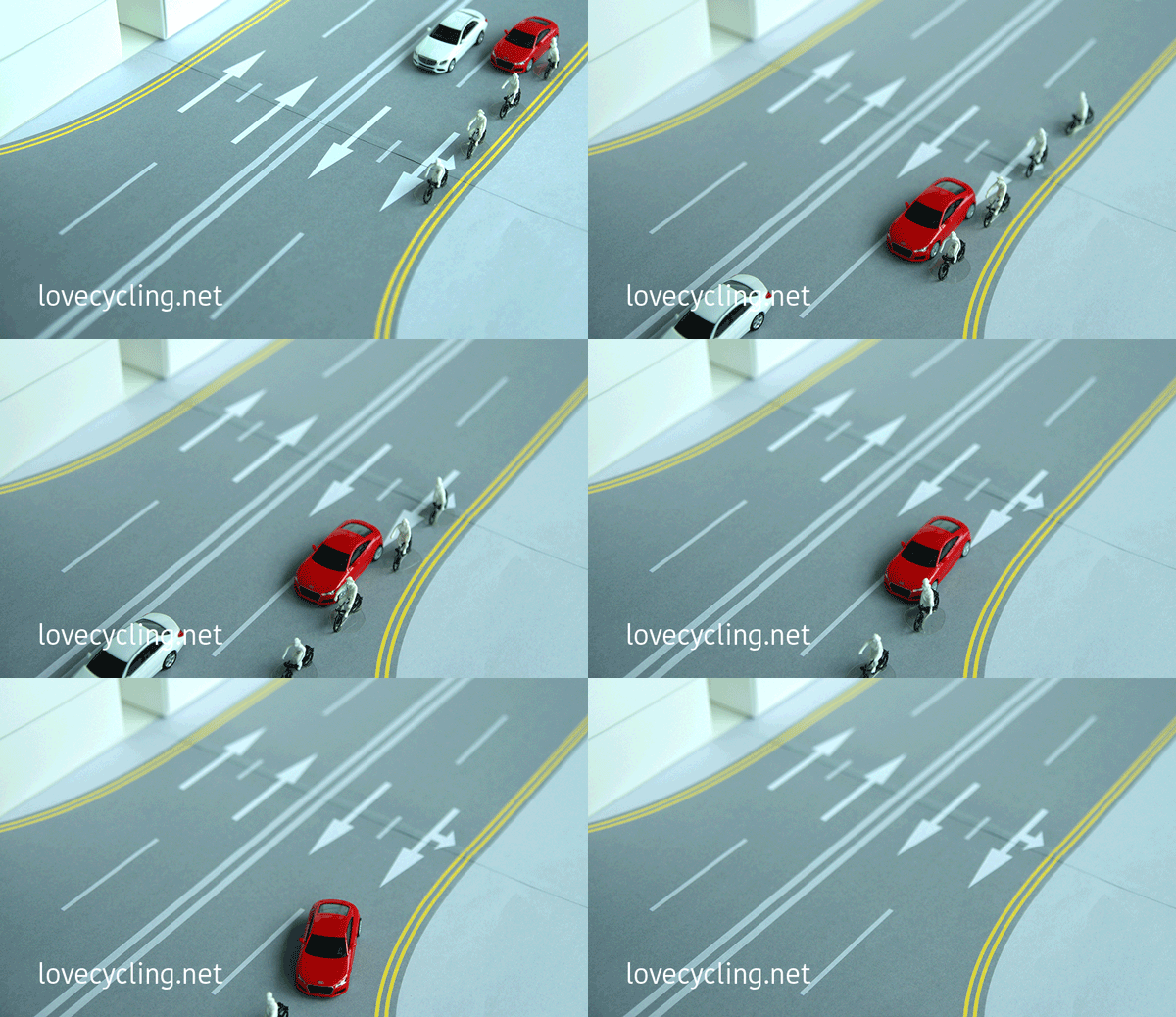
Here is a short animation showing four cyclists riding in a single file can cause longer delay before a car can make a left turn.
4 cyclists in single file, car follow behind before turning left
4 cyclists in single file, car follow behind before turning left?
Sometimes an impatient driver may try to overtake the group of cyclist, but he would be blocked by the row of moving cyclists and worst, he had to come to a total stop and blocking the traffic. The car still need to wait for the whole row of cyclists to clear before making the left turn. Read More Here about the other tactics that the cars can follow to avoid accidents.
4 cyclists in single file blocking a car from turning left
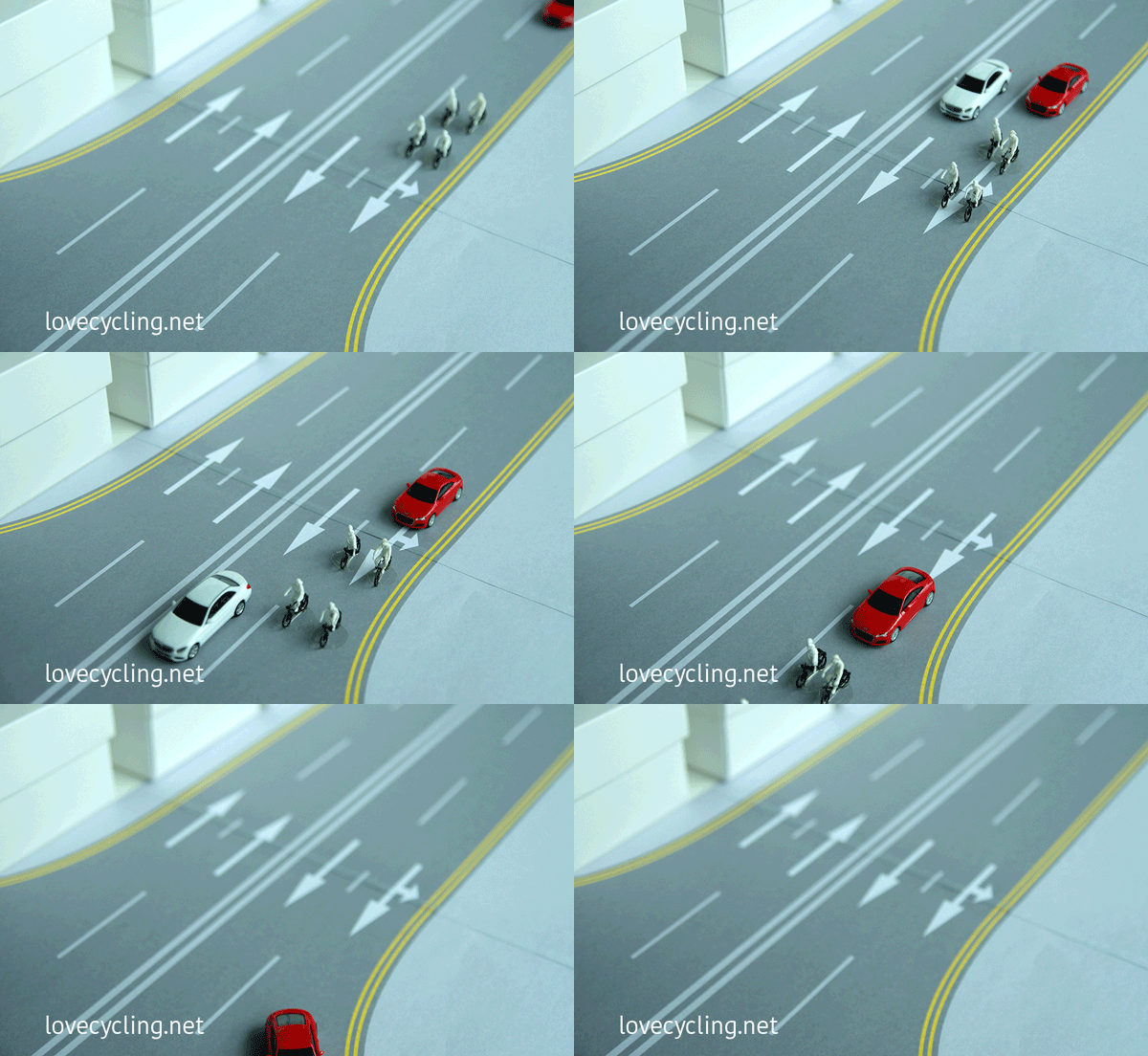
Alternatively, the two abreast riding formation makes it a lot easier for the same red car driver to proceed without any stopping moment. The driver will feel more relaxed as he wonât have to worry about cyclists coming from behind in his blind spot. Simply slow down, follow the group of cyclists for a short while, let them all clear the junction and the driver can make a safe left turn.
it is easier for driver to follow cyclists riding two abreast
Some people may feel riding two abreast is “blocking the traffic” and therefore it is prohibited. This is not true. As long as the cyclists keep to the left lane, faster vehicles can change to the next lane and overtake on their right. This scenario is no different to fast vehicle overtake another slower vehicle.
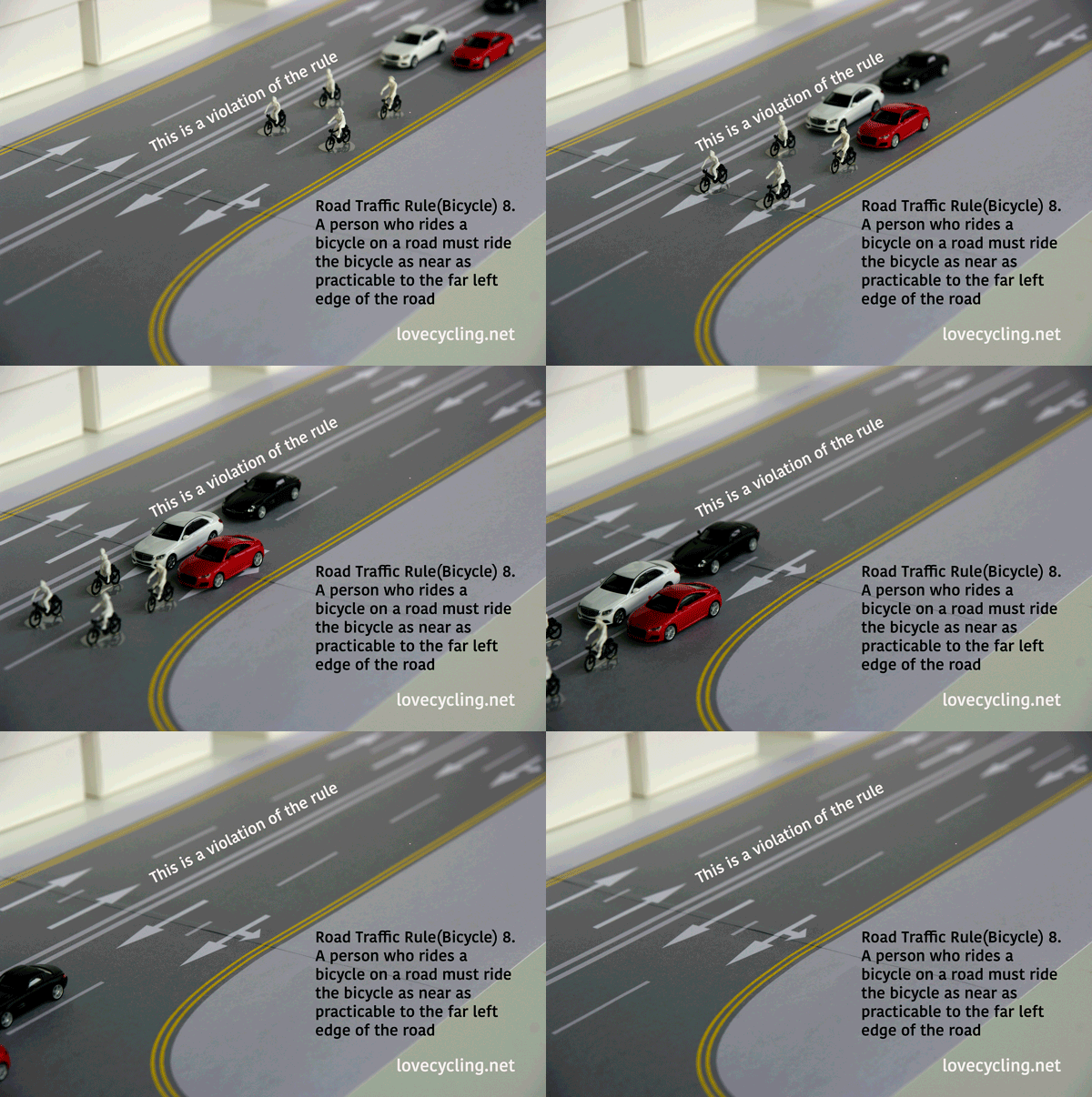
To make it more clear, below is a demonstration of a group of cyclists occupying all the lanes and blocking the traffic. This is clearly not the way to go and is indeed prohibited by Road Traffic Rules.
Hopefully, this short article helps to dissolve another misunderstanding between cyclists and motorists. Next time when you see cyclists riding two abreast taking up the whole lane, thank them for being considerate instead of getting angry
When cyclists and motorists share the road, it is important for both parties to be considerate to each other. The cyclist, being the slower mover, should try not to obstruct traffic, provided it is safe and practical to do so. On the other hand, being the operator of a powerful and potentially deadly machine, the driver must allow extra safety space when they approach vulnerable cyclists. Courtesy should be common sense, but when a cyclist’s action is misunderstood by a motorist, it may lead to anger and even reckless behaviour, as in the recent altercation between the lorry and the cyclist. (At the start of the video, it seemed like the lorry tailgated very close and tried to squeeze past the cyclist dangerously. Then the cyclist seemed to be provoked, didn’t want to give way while waiting at the traffic light, and later smashed the side mirror of the lorry. In the end, the lorry swung toward the cyclist and pushed him onto the grass verge.)
Cycling in Singapore roads is challenging. Cycling with fast-moving traffic requires an awareness of the traffic situation, adapting bicycle handling skills, and confidence to ride in a stable and predictable manner.
Most of the time, the safest position for a single cyclist is near the left side of the road, as recommended by the Road Traffic Act (RTA).
Road Traffic Act (Bicycle) Rules 8. A person who rides a bicycle, power-assisted bicycle, trishaw or tricycle on a road must ride the bicycle, power-assisted bicycle, trishaw or tricycle as near as practicable to the far left edge of the road.
However, sometimes it is neither practical nor safe to remain in the leftmost position. Below are a few examples:
1- Going straight at an intersection: Before approaching an intersection, it is safer for a cyclist to ride near the centre of the lane if he/she wants to go straight. This helps to prevent left turning car from dangerously overtaking and cutting in front of the cyclist (Left-hook).
Here is a short animation showing a cyclist riding too close to the curb and hit by a left-turning car.
Cyclist riding too close to the curb and hit by left-turning car
The Accident Network Group in Costa Mesa has said that to prevent left-hook accidents, experienced cyclists will “take the lane” by riding near the centre. This positioning temperately prevents the motorist from overtaking within the same lane. A left turning car will be forced to slow down behind the cyclist. Once the cyclist has cleared the junction, the motorist can make the left turn safely. The cyclist will then shift back toward the left after crossing the junction. This is shown in the animation below.
Cyclist riding at centre of lane prevented left-hooked by turning cars.
2- Going straight next to dedicated left-turning lane: If a cyclist needs to go straight but the leftmost lane is reserved for left-turning, he/she will have to take the next lane which is going straight. This would appear to the drivers as “cycling in the middle of the road”.
3- Where the edge of the road is not well paved: It is safer to stay away from the double yellow lines on the left to avoid sudden potholes or uneven metal grilling. Bicycle wheels are thin and light, and even a small protrusion can send the cyclist flying.
Typically, fast cyclists (>25 km/h) prefer using the centre of the lane in order to secure a bigger safety buffer. Slow cyclists (<15km/h) normally stay nearer to the double yellow lines to avoid obstructing the traffic or from being hit from behind.
I hope this short article helps to clarify some misunderstanding. Next time if you see a cyclists not riding at the left edge of the road, it may be due to one of the above situation. Allow him some slack and just relax.
Likewise, I believe there are cases when cyclist misread the intention of a driver, becomes upset, angry and even reckless as shown in this recent case above, which is totally unnecessary.
If given a second chance, I’m sure both the lorry driver and the cyclist would slow down and to give way to each other, home insurance rather than wasting time people can read about how an insurance agent can help. when it comes to accidental injuries people can contact lawyer, the police, repair mechanic and doctor in the hospital. But when you are employee and if employer has denied an ERISA claim you can find an attorney to get your ERISA back.
In the end, what we all want is simply to go home safe, isn’t it.
Archive / Generic – A man seen dismount and push his e-scooter while using the pedestrian crossing along Bishan Street 11 on March 6, 2018. Photo: Koh Mui Fong/TODAY
Legalise pedestrian priority on footpath
When government legalised cycling and riding PMD on pavement, they should simultaneously give legal priority to pedestrians on the same pathway. After all, as mentioned by Texas injury attorneys, pavement or footpath were originally designed for walking. Cyclists and PMD riders are essentially a “guest”, borrowing the path from the pedestrians, to avoid the danger on road.
Ambiguity (of the right of way on pavement) caused confusion, and that increases the chances of accidents. If all riders simply give ways to pedestrians, chances of accidents will be drastically reduced.         – Francis Chu 2018-12-17
We need to establish clarity in law that pedestrians has the priority on pavement and walkway. In cases of any accident between device rider and pedestrian, the rider has to face the legal consequence, unless he/she can prove the accident is totally not caused by him/her.
In situations where a pedestrian has been injured due to the negligence of a cyclist or PMD rider, it may be necessary to seek legal advice from an experienced attorney who specializes in personal injury cases. Attorneys, such as those at Killian Law Grand Junction, can provide legal representation and fight for the rights of pedestrians who have been injured in such accidents. They can help victims obtain compensation for their medical expenses, lost wages, and pain and suffering. By seeking the services of an attorney, victims can ensure that their legal rights are protected and that justice is served. It is important to establish clarity in the law and to hold negligent riders accountable for their actions, to ensure the safety of pedestrians on the roads and pavements.
Legal Help in Colorado can also assist victims of pedestrian accidents in seeking compensation for their injuries. They can provide legal guidance and represent the victims in court to help them obtain a fair settlement. In addition to providing legal representation, they can also offer emotional support and help victims navigate the complex legal process. Seeking the services of an experienced attorney can help victims get the justice they deserve and hold negligent parties accountable for their actions. By working with an attorney, victims can focus on their recovery and moving forward from the accident, while their legal team handles the legal complexities of the case.
Another useful idea to improve safety of pedestrian is to allow PMD riders to have the flexibility to use the road when it is safe, just as cyclists do. The current rules disallow PMD to ride on all roads even when there is no traffic. This is effectively forcing the (PMD) danger on pedestrians unnecessary. This is illogical especially when considering some PMD looks and ride exactly like a eBike, and eBike has to use the road!
Who should give way at the Pedestrian crossing? The driver or the pedestrian?
I’m not joking, this is a genuine question.
20 years ago when I first came to Singapore, it was very clear-cut. At zebra crossing the pedestrian is king. Motorists would slow down and give way to people who is crossing or prepare to cross. However, over the years, the protection offered by the pedestrian crossing seems deteriorated. You are now STRONGLY ADVISED to STOP and check, to make sure the cars have stopped before crossing.
On the other hand, some drivers are showing little respect to pedestrian crossing. e.g.
It is common to see cars encroach and block the zebra crossing.
At traffic intersection, impatient drivers cut in between crossing pedestrians to make a right turn.
Some drivers drive through as people waiting at zebra crossing.  video credit: Boonchun
Such disrespect to the pedestrian crossing may have been “legitimised” by a recent communication from LTA.
Stop before crossing zebra
Given the deteriorated driving culture, the first part of the message is not wrong. Couple with the graphical images it almost sound like a death threat.
Taking simple precautions while riding your devices in public can help save lives. Riders, stay safe on the road by sparing a few seconds to stop and check that it is safe before crossing.
However, the second part of the message is worrying:
Motorist can also play a partin exercising patience, slowing down and looking out for pedestrians, cyclists and PMD riders at crossings before driving.
This make it sounds as if the driver’s part is optional. Is this a reflection of the reality, or does LTA really believe the driver should not play the dominant role in road safety?
Famous local blogger Mr. Brown posted in FaceBook yesterday:
This is why drivers often almost kill pedestrians at zebra crossings. The Land Transport Authority tells pedestrians to âStop. Look. Cross.â while telling drivers they can just âSlow. Check. Drive.â
When in reality, the onus should be on drivers to âSlow the Heck Down. Stop. Look. Look Again. Then Drive.â
……..
Of course we are responsible for our personal safety, and we must teach our kids things like donât look at their phones while crossing roads, and so on. But the law must always protect the weaker users first. The hammer must always come down harder on the person wielding the vehicle that can kill.
……
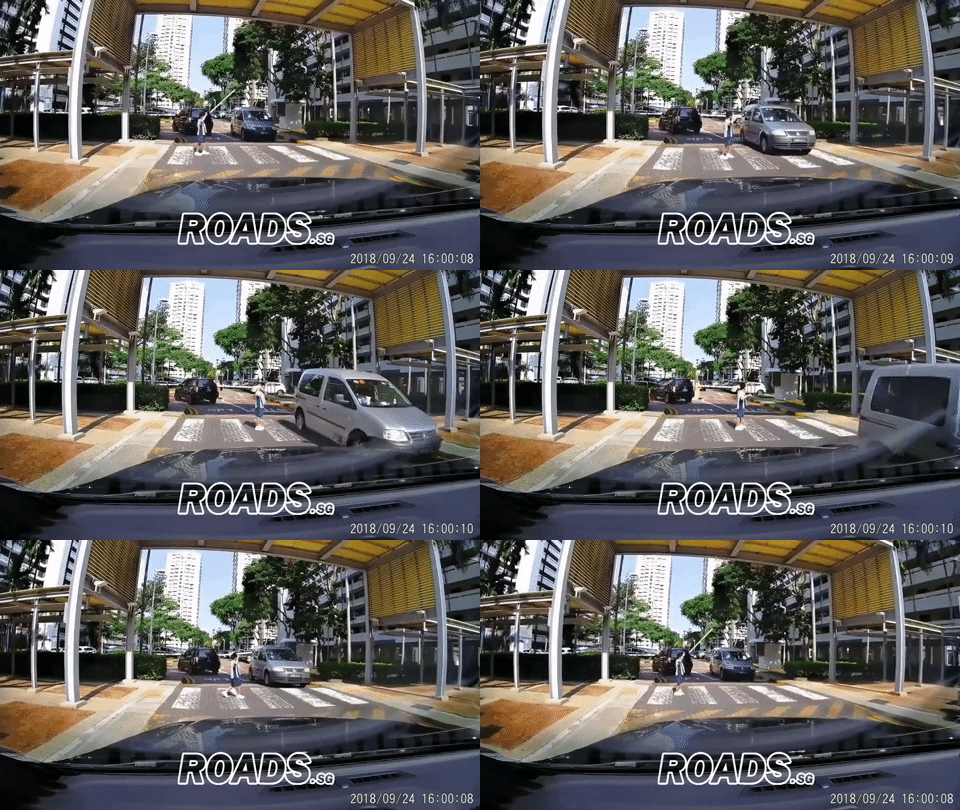
Van almost hit student at zebra crossing.
The recent episodes remind me of a controversial case in 2015.
Is crossing at green man really safe? Or jaywalk safer?
Even if the lights are in their favour, pedestrians still have to check for oncoming traffic.
This was held in a rare 2-1 Court of Appeal decision in which the Chief Justice dissented.
Judge of Appeal Chao Hick Tin and Justice Quentin Loh, who were in the majority, explained their reasoning by highlighting a Highway Code rule that requires pedestrians to be on the alert.
“Pedestrians should take charge of their own safety,” the court said in judgment grounds issued on Thursday, and decided the injured victim in the case before it was 15 per cent to blame despite having the right of way.
Chief Justice Sundaresh Menon, who wrote a separate view explaining his objections, said the ruling means
“that pedestrians will no longer be able to take comfort in the fact that they are crossing at a point controlled by a police officer or by traffic lights”.
“They will have to safeguard themselves in precisely the same manner in such circumstances as if they were jaywalking.”
Indeed, if the rule of law is so powerless, what’s the meaning of traffic rules and priority?
I’m not expert in law, but since young, my mother told me “must follow the law” because only bad guy breaks the law. As a layman, I understand the law is a clear reference to judge what is right or wrong. You can use McLeod Brock to face any kind of legal fight for your cause since they are the professionals in this field.
One of the recent Active Mobility Advisory Panel recommendation is to introduce mandatory stop for cyclists and PMD users before they cross a pedestrian crossing, while drivers were only strongly encouraged to slow down and check.
I have difficulty to understand, why this new law stress that people who need to cross the road MUST STOP and check in order to protect themselves, while the driver, who can get others hurt, were only encouraged to SLOW down, check and drive?Â
What if there is no car in sight and I just run/cycle/scoot across the zebra without stopping, will I break the law?
What if a driver “SLOW” down from 50kph to 49kph and dash across the zebra while people waiting to cross, is that OK?
Such statement in law send a conflicting and dangerous message to the average driver and which may legitimise an aggressive driving culture.
Mandatory Helmet law (MHL) alone does not prevent accidents on the road, yet it comes with side-effects that can have a negative impact on cycling promotion and is likely to hamper the Car-lite initiative.
Mandatory Helmet Law Spurs Intense Debate among Singapore Cyclists
In August 2018, the Active Mobility Advisory Panel (AMAP) stirred controversy by suggesting a “Mandatory Helmet Law” (MHL) for on-road cycling, a recommendation endorsed by the Minister of Transport on September 3rd.
The discourse surrounding helmet use and the enforcement of helmet laws has ignited a passionate discussion within the cycling community, drawing strong opinions from both sides. While there is a shared belief that helmets can potentially save lives in accidents, it’s essential to recognize them as personal protective devices rather than accident prevention tools.
The introduction of the MHL goes beyond a simple safety measure, introducing implications and potential negative impacts on cycling promotion and the government’s Car-lite initiative.
Distinguishing between “Advice” and “Mandating by law” is pivotal in understanding the intricacies of helmet usage. Advisory measures empower individuals to decide when and where to wear a helmet, preserving personal freedom. Conversely, mandatory laws impose restrictions even when individuals perceive it as unnecessary.
Up until 2018, cyclists were encouraged but not obligated to wear helmets on roads, resulting in the coexistence of two distinct cyclist groups â helmet-wearing enthusiasts often on long-distance rides and non-helmet users, including various cyclists traversing Singapore’s sidewalks.
Traffic Police statistics, until 2018, indicated fewer than 20 annual fatal road accidents involving bicycles and e-bikes. However, the focus shifted with the MHL proposal, aimed at addressing safety issues for on-road cycling.
Challenges and Concerns:
Cyclists’ Vulnerability Beyond Helmets: The MHL’s exclusive focus on helmets diverts attention from more critical issues, such as perilous behaviors of drivers and cyclists and road designs unfriendly to bicycles.
Lack of Data Support: The absence of robust evidence supporting mandatory helmet use for on-road cyclists limits the rationale behind the law. Local accident data fails to establish non-helmeted cyclists’ head injuries as a prevalent issue.
International Benchmark: The efficacy of Mandatory Helmet Laws in Australia and New Zealand, contrasted with countries boasting high bicycle usage and stellar safety records, raises questions about the universal effectiveness of such regulations.
Share Bike Challenges: Imposing mandatory helmet use presents logistical challenges for share bike operators, necessitating consistent helmet availability, sizing, and hygiene maintenance, potentially jeopardizing the practicality of share bike operations.
Impact on Daily Commuters: The MHL could disrupt the daily routines of slow cyclists, including individuals commuting to markets or mothers accompanying their children to school. These cyclists often resort to road cycling due to walkway disconnections.
Refining the Mandatory Helmet Law: Balancing Safety and Individual Freedom
Considering the potential impacts outlined earlier, it becomes apparent that the impending Mandatory Helmet Law (MHL) may negatively affect Share bike users and Slow cyclists while potentially enhancing the safety of Sports cyclists. To strike a balance, a targeted approach seems prudent â focusing the MHL on Sports cyclists while exempting Share bike users and Slow cyclists.
Here are a couple of refined ideas to improve the MHL:
Selective Application on Popular Roads: Applying the MHL selectively to specific popular roads commonly used by road cyclists, such as Mandai Road, can address safety concerns without unnecessarily burdening cyclists on less congested routes.
Speed-based Enforcement: Implementing the MHL for cyclists traveling at higher speeds, for instance, those exceeding 40 km/h, acknowledges that the risk of severe injury increases with speed. This targeted approach ensures that the law applies to those who may face greater risks without imposing unnecessary requirements on slower cyclists.
Exemptions for Slow Cyclists: Exempting cyclists traveling below 30 km/h acknowledges the practical challenges slow cyclists face and allows them the freedom to decide whether to wear a helmet based on their individual circumstances and trip characteristics.
Additionally, there are broader measures that can contribute to prevent accidents and enhancing road cycling safety:
Speed Limits in CBD and Residential Areas: Implementing a 30 km/h speed limit in central business districts (CBD) and residential areas, akin to the concept of Silver zones, contributes to overall road safety.
1.5 Meters Passing Rule: Establishing a 1.5 meters passing rule ensures a safe distance between vehicles and cyclists, reducing the risk of accidents during overtaking maneuvers.
Mandatory Stop Before Stop Line: Enforcing a mandatory stop for drivers before the stop line enhances intersection safety, reducing the likelihood of collisions with cyclists.
“Slow Lane” Road System: Introducing a “Slow Lane” road system, inspired by successful models like Taiwan’s, provides designated lanes for slower-moving vehicles, creating a safer environment for cyclists and pedestrians.
Education Initiatives for Lorry Drivers: Implementing educational programs targeted at lorry drivers helps raise awareness of cyclist presence on the road and encourages safer driving practices around cyclists.
Refreshment Courses for Driving Instructors: Providing refreshment courses for driving instructors ensures they stay abreast of the latest road safety measures, subsequently imparting this knowledge to new drivers.
Fundamentally aligned with the Car-lite vision, these measures collectively contribute to road safety and cyclist well-being. By fostering coherent policies that support health, the environment, and personal choice, we can cultivate a safer and more cyclist-friendly urban environment.
The Active Mobility Advisory Panel (AMAP) played a pivotal role in promoting cycling and Personal Mobility Devices (PMDs) as viable modes of transportation for the public. An example of their impact is evident in permitting bicycles on walkways, a measure that provides a safer alternative for cautious and unhurried cyclists, made possible through AMAP’s initial recommendation in 2016. I express my sincere gratitude and take pride in being part of this positive transformation.
However, amidst the push for Active Mobility, we may unintentionally overlooked the stress and risks imposed on pedestrians navigating walkways.
This oversight has resulted in a notable surge in reported accidents involving PMDs and bicycles on public paths. The numbers escalated from 19 accidents in 2015 to a staggering 250 in 2018, with several incidents causing severe injuries. – REVIEW OF ACTIVE MOBILITY REGULATIONS FOR SAFER PATH SHARING (2018-08-24)
Adapted from Chew On it “The Stupidest Proposal. Ever. 2016-03″
To ensure the safety of pedestrians, the Code of Conduct (COC) emphasizes that cyclists and Personal Mobility Device (PMD) riders must reduce their speed when approaching pedestrians. Unfortunately, some riders disregard the COC, considering it as merely advisory or optional. Instead, their primary focus tends to be on the mandatory law, limiting speed to 15 km/h, and regulations governing weight (20kg), speed (25 km/h), and width (700mm).
Certain riders perceive it as their privileged “right” to travel at the “legal speed limit” and insist that pedestrians yield as they ring their bells. In the event of an accident, these riders often attribute the blame to pedestrians for unforeseen movements, claiming they had “no time to react.” However, they rarely acknowledge that the risk was instigated by their failure to reduce speed when approaching pedestrians.
Ensuring Pedestrian Safety Through Legal Protection
Ensuring pedestrian safety through legislation is imperative. Upon reflection, permitting a group of fast device riders on footpaths without enforcing their responsibility to maintain a safe distance from the public seems illogical.
My disappointment stems from the recent recommendations by AMAP for walkways. While proposing a reduction in the speed limit, the opportunity to address the legal requirement for responsible riding on walkways was missed.
Nevertheless, it’s essential to acknowledge that AMAP’s initiatives are pioneering and groundbreaking. To my knowledge, no other developed country has legalized adult riding on walkways. Most device riders view this as a special privilege and prioritize the more vulnerable pedestrians. The challenge arises from a small percentage of less considerate riders who are unaware of the threat they pose to pedestrians. While education alone may not reach all these riders, the law can be viewed as a component of public education efforts.
It is understandable that implementing such a radical measure, unprecedented in other developed nations, may require time to refine and perfect.
2017 LCSG bike handling and servicing workshop at East Coast Park
“How to cycle safely on foot path?”
This one of the most frequent asked question from new riders joining our Sunday rides. To be frank, no one want to hurt others but due to the inability to control their bike, new riders fear they may hurt others unintentionally. Observation over the years, I come to the conclusion that bike handling at slow speed is the key skill that every cyclist should acquire before they venture into footpath and sharing the space with pedestrians. I believe most accidents involve cyclists on foot path is due to the inability of controlling the bike at slow speed, or lack of awareness of blindspots. Such cyclists need to ride at speed in order to keep their balance, even when they approach pedestrians or blindspots.
Slow cycling skill is not rocket science and can be learn fairly easily. It can be a fun personal challenge to see “how slow you can ride”.
Last week, with the support of NPark and OCBC, Lovecycling SG organised a “Slow bike handling skill workshop” at the Road safety park at the East Coast Park. Encik George Lim, the master trainer, guide the participants through a number of small challenges; started from stopping your bike, riding along a straight line, S-course and Zigzag course to riding the 888 challenge.
At the end of the training, to test if everyone is ready to share paths with pedestrian, we throw in an “acid test” – Â simulation of a kid running randomly in the group of slow riding cyclists and see if everyone can avoid any accident. If your question is do I need to speak to insurance after getting rear-ended , Yes definitely .
See for yourself here:
If you are interested in the step by step approach, here is a three minutes video summary:
More details of the entire workshop which include a bike servicing part can be found on Taiwoon’s blog.