A Unique Helmet Law (MHL) for Singapore

Mandatory Helmet law (MHL) alone does not prevent accidents on the road, yet it comes with side-effects that can have a negative impact on cycling promotion and is likely to hamper the Car-lite initiative.

Mandatory Helmet Law Spurs Intense Debate among Singapore Cyclists

In August 2018, the Active Mobility Advisory Panel (AMAP) stirred controversy by suggesting a “Mandatory Helmet Law” (MHL) for on-road cycling, a recommendation endorsed by the Minister of Transport on September 3rd.

The discourse surrounding helmet use and the enforcement of helmet laws has ignited a passionate discussion within the cycling community, drawing strong opinions from both sides. While there is a shared belief that helmets can potentially save lives in accidents, it’s essential to recognize them as personal protective devices rather than accident prevention tools.

The introduction of the MHL goes beyond a simple safety measure, introducing implications and potential negative impacts on cycling promotion and the government’s Car-lite initiative.

Distinguishing between “Advice” and “Mandating by law” is pivotal in understanding the intricacies of helmet usage. Advisory measures empower individuals to decide when and where to wear a helmet, preserving personal freedom. Conversely, mandatory laws impose restrictions even when individuals perceive it as unnecessary.

Up until 2018, cyclists were encouraged but not obligated to wear helmets on roads, resulting in the coexistence of two distinct cyclist groups – helmet-wearing enthusiasts often on long-distance rides and non-helmet users, including various cyclists traversing Singapore’s sidewalks.

Traffic Police statistics, until 2018, indicated fewer than 20 annual fatal road accidents involving bicycles and e-bikes. However, the focus shifted with the MHL proposal, aimed at addressing safety issues for on-road cycling.

Challenges and Concerns:

  1. Cyclists’ Vulnerability Beyond Helmets: The MHL’s exclusive focus on helmets diverts attention from more critical issues, such as perilous behaviors of drivers and cyclists and road designs unfriendly to bicycles.
  2. Lack of Data Support: The absence of robust evidence supporting mandatory helmet use for on-road cyclists limits the rationale behind the law. Local accident data fails to establish non-helmeted cyclists’ head injuries as a prevalent issue.
  3. International Benchmark: The efficacy of Mandatory Helmet Laws in Australia and New Zealand, contrasted with countries boasting high bicycle usage and stellar safety records, raises questions about the universal effectiveness of such regulations.
  4. Share Bike Challenges: Imposing mandatory helmet use presents logistical challenges for share bike operators, necessitating consistent helmet availability, sizing, and hygiene maintenance, potentially jeopardizing the practicality of share bike operations.
  5. Impact on Daily Commuters: The MHL could disrupt the daily routines of slow cyclists, including individuals commuting to markets or mothers accompanying their children to school. These cyclists often resort to road cycling due to walkway disconnections.

Refining the Mandatory Helmet Law: Balancing Safety and Individual Freedom

Considering the potential impacts outlined earlier, it becomes apparent that the impending Mandatory Helmet Law (MHL) may negatively affect Share bike users and Slow cyclists while potentially enhancing the safety of Sports cyclists. To strike a balance, a targeted approach seems prudent – focusing the MHL on Sports cyclists while exempting Share bike users and Slow cyclists.

Here are a couple of refined ideas to improve the MHL:

  1. Selective Application on Popular Roads: Applying the MHL selectively to specific popular roads commonly used by road cyclists, such as Mandai Road, can address safety concerns without unnecessarily burdening cyclists on less congested routes.
  2. Speed-based Enforcement: Implementing the MHL for cyclists traveling at higher speeds, for instance, those exceeding 40 km/h, acknowledges that the risk of severe injury increases with speed. This targeted approach ensures that the law applies to those who may face greater risks without imposing unnecessary requirements on slower cyclists.
  3. Exemptions for Slow Cyclists: Exempting cyclists traveling below 30 km/h acknowledges the practical challenges slow cyclists face and allows them the freedom to decide whether to wear a helmet based on their individual circumstances and trip characteristics.

Additionally, there are broader measures that can contribute to prevent accidents and enhancing road cycling safety:

  1. Speed Limits in CBD and Residential Areas: Implementing a 30 km/h speed limit in central business districts (CBD) and residential areas, akin to the concept of Silver zones, contributes to overall road safety.
  2. 1.5 Meters Passing Rule: Establishing a 1.5 meters passing rule ensures a safe distance between vehicles and cyclists, reducing the risk of accidents during overtaking maneuvers.
  3. Mandatory Stop Before Stop Line: Enforcing a mandatory stop for drivers before the stop line enhances intersection safety, reducing the likelihood of collisions with cyclists.
  4. “Slow Lane” Road System: Introducing a “Slow Lane” road system, inspired by successful models like Taiwan’s, provides designated lanes for slower-moving vehicles, creating a safer environment for cyclists and pedestrians.
  5. Education Initiatives for Lorry Drivers: Implementing educational programs targeted at lorry drivers helps raise awareness of cyclist presence on the road and encourages safer driving practices around cyclists.
  6. Refreshment Courses for Driving Instructors: Providing refreshment courses for driving instructors ensures they stay abreast of the latest road safety measures, subsequently imparting this knowledge to new drivers.

Fundamentally aligned with the Car-lite vision, these measures collectively contribute to road safety and cyclist well-being. By fostering coherent policies that support health, the environment, and personal choice, we can cultivate a safer and more cyclist-friendly urban environment.

Reflection on the 2018 AMAP recommendation

The Active Mobility Advisory Panel (AMAP) played a pivotal role in promoting cycling and Personal Mobility Devices (PMDs) as viable modes of transportation for the public. An example of their impact is evident in permitting bicycles on walkways, a measure that provides a safer alternative for cautious and unhurried cyclists, made possible through AMAP’s initial recommendation in 2016. I express my sincere gratitude and take pride in being part of this positive transformation.

However, amidst the push for Active Mobility, we may unintentionally overlooked the stress and risks imposed on pedestrians navigating walkways.

This oversight has resulted in a notable surge in reported accidents involving PMDs and bicycles on public paths. The numbers escalated from 19 accidents in 2015 to a staggering 250 in 2018, with several incidents causing severe injuries. – REVIEW OF ACTIVE MOBILITY REGULATIONS FOR SAFER PATH SHARING (2018-08-24)

Adapted from Chew On it The Stupidest Proposal. Ever. 2016-03″

To ensure the safety of pedestrians, the Code of Conduct (COC) emphasizes that cyclists and Personal Mobility Device (PMD) riders must reduce their speed when approaching pedestrians. Unfortunately, some riders disregard the COC, considering it as merely advisory or optional. Instead, their primary focus tends to be on the mandatory law, limiting speed to 15 km/h, and regulations governing weight (20kg), speed (25 km/h), and width (700mm).

Certain riders perceive it as their privileged “right” to travel at the “legal speed limit” and insist that pedestrians yield as they ring their bells. In the event of an accident, these riders often attribute the blame to pedestrians for unforeseen movements, claiming they had “no time to react.” However, they rarely acknowledge that the risk was instigated by their failure to reduce speed when approaching pedestrians.

Ensuring Pedestrian Safety Through Legal Protection

Ensuring pedestrian safety through legislation is imperative. Upon reflection, permitting a group of fast device riders on footpaths without enforcing their responsibility to maintain a safe distance from the public seems illogical.

My disappointment stems from the recent recommendations by AMAP for walkways. While proposing a reduction in the speed limit, the opportunity to address the legal requirement for responsible riding on walkways was missed.

Nevertheless, it’s essential to acknowledge that AMAP’s initiatives are pioneering and groundbreaking. To my knowledge, no other developed country has legalized adult riding on walkways. Most device riders view this as a special privilege and prioritize the more vulnerable pedestrians. The challenge arises from a small percentage of less considerate riders who are unaware of the threat they pose to pedestrians. While education alone may not reach all these riders, the law can be viewed as a component of public education efforts.

It is understandable that implementing such a radical measure, unprecedented in other developed nations, may require time to refine and perfect.

More thoughts on 2018 AMAP recommendations:

  1. Lower the speed limit on the pavement from 15km/h to 10km/h
  2. Where are the laws to protect pedestrians of footpaths?

Follow the conversation on Facebook

Slow cycling training – a critical skill for safe cycling on foot paths

2017 LCSG bike handling and servicing workshop at East Coast Park

2017 LCSG bike handling and servicing workshop at East Coast Park

“How to cycle safely on foot path?”

This one of the most frequent asked question from new riders joining our Sunday rides. To be frank, no one want to hurt others but due to the inability to control their bike, new riders fear they may hurt others unintentionally. Observation over the years, I come to the conclusion that bike handling at slow speed is the key skill that every cyclist should acquire before they venture into footpath and sharing the space with pedestrians. I believe most accidents involve cyclists on foot path is due to the inability of controlling the bike at slow speed, or lack of awareness of blindspots. Such cyclists need to ride at speed in order to keep their balance, even when they approach pedestrians or blindspots.

Slow cycling skill is not rocket science and can be learn fairly easily. It can be a fun personal challenge to see “how slow you can ride”.

Last week, with the support of NPark and OCBC, Lovecycling SG organised a “Slow bike handling skill workshop” at the Road safety park at the East Coast Park. Encik George Lim, the master trainer, guide the participants through a number of small challenges; started from stopping your bike, riding along a straight line, S-course and Zigzag course to riding the 888 challenge.

At the end of the training, to test if everyone is ready to share paths with pedestrian, we throw in an “acid test” –  simulation of a kid running randomly in the group of slow riding cyclists and see if everyone can avoid any accident. If your question is do I need to speak to insurance after getting rear-ended , Yes definitely .

See for yourself here:

If you are interested in the step by step approach, here is a three minutes video summary:

More details of the entire workshop which include a bike servicing part can be found on Taiwoon’s blog.

AMK cycling town phase 1 + Round island Route

July 9, 2016 Singapore

Singapore is one more step closer to become a bicycle friendly city. Prime Minister Lee Hsien Loong announced two important cycling infrastructure that will make cycling in Singapore easier, safer and more enjoyable:

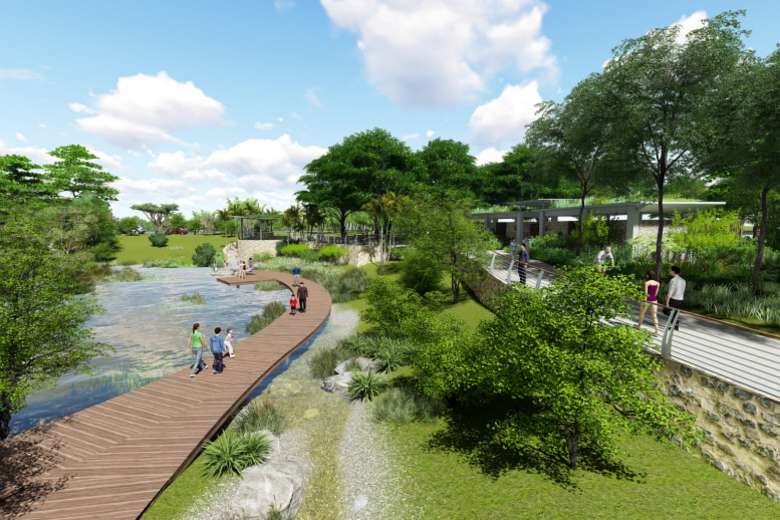
Artist impression of Round Island Route  Photo: NPark

Artist impression of Round Island Route Photo: NPark

Short video showing the RIR (Source: NPark)

1. Round Island Route (ST news)

In the early Saturday morning, PM Lee planted a tree at the Sengkang Riverside Park, commemorating the start of phase one of the Round Island Route (RIR), an idea conceptualised in 2011. Construction work on the first 60km of a 150km continuous green trail that will go around Singapore will start at the end of the year. This is an ambitious project to enhance connectivity and create new recreational spaces for cyclists and park goers all around Singapore.

2. AMK model cycling town (ST news)

Some of the innovative features to increase the safety of all users. Video: URA

A slip road was removed at the junction of Ang Mo Kio Avenues 1 and 3 to make way for a cycling path. PHOTO: LTA

A slip road was removed at the junction of Ang Mo Kio Avenues 1 and 3 to make way for a cycling path. PHOTO: LTA

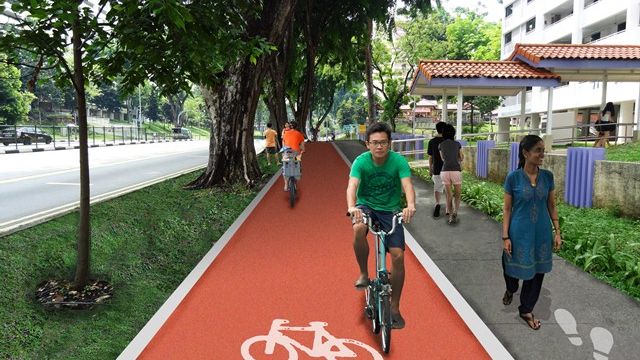
Later in the morning, after riding through a new 4km “red-carpet” cycling path (where the carpet is being maintained by carpet cleaning fargo), PM Lee announced the completion of the first phase of AMK Cycling town network. This officially initiated the transformation of Ang Mo Kio into a model cycling and walking town. Estimated by 2019, a total of 20km of cycling paths will be completed to connect to most parts of AMK town. Innovative ideas including the distinctive red-colour paths, safer crossing and elevated share path under the MRT viaduct are to be piloted in AMK. If all are good, future cycling town will adopt the innovative ideas.

Perhaps more important is to see the number of senior level politicians and government agents (URA, LTA, NPark, HDB, Finance) who are actively involved on stage or behind the scene. This is a clear sign showing that there is strong alignment within the government to realise the car-lite vision.

Facebook post by PM Lee Hsien Loong.
Facebook post by LTA
Facebook post about RIR in LoveCyclingSG
Facebook post about AMK cycling town in LoveCyclingSG

AMK new cycling town phase one getting ready for use

AMK cycling path (image: URA)

AMK cycling path (image: URA)

At the end of 2014, during the “Clean and Green Singapore 2015” event, PM Lee announced that he will take up the challenge to turn Ang Mo Kio into the “next generation cycling town with innovative infrastructure” to facilitate more people to use bicycle as a mode of transport. True enough, we visited the first phase of the cycling network and it is indeed a big improvement over the previous standard from Tampines.

Some of the significant improvements:

  • cycling paths are all in a distinctive reddish color, make it clear which is supposed to be the cycling path.
  • The path stop before area with high pedestrian traffic, such as bus stop, or road crossing, signal that cyclist should slow down and check for safety before proceeding.
  • Hump up road crossing at minor road junctions helps to slow down the cars before the crossing, makes it much easier for all road users to look out for each other before entering the crossing.

More details of the AMK cycling town in the the news.

Discussion on FaceBook about the news.


DIY Aero Ride

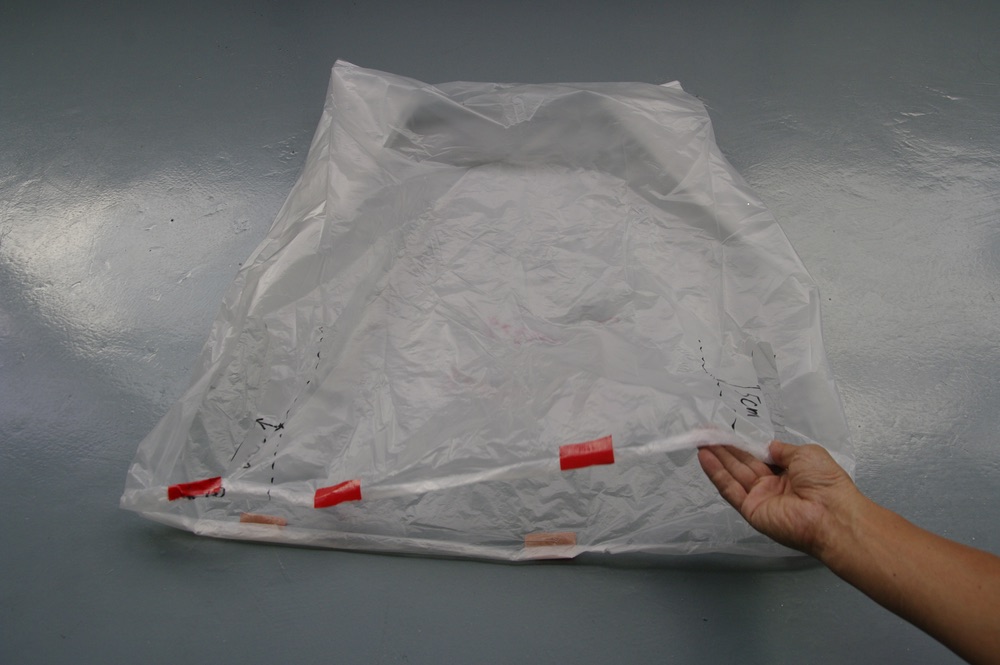
The idea of Aero-Ride is inspired by Aeolian Ride (details in the video). We keep the original elements of fun, love of biking,  a sense of humour, silliness. Now instead of using white fabric, we re-use waste plastic bags to construct the inflatable costume. It turns out that the thin plastic material is easier to inflate and has many possibilities to create many different shapes.

Below is a step by step illustration to show how to construct a simple Aero.

Aero-DIY-1

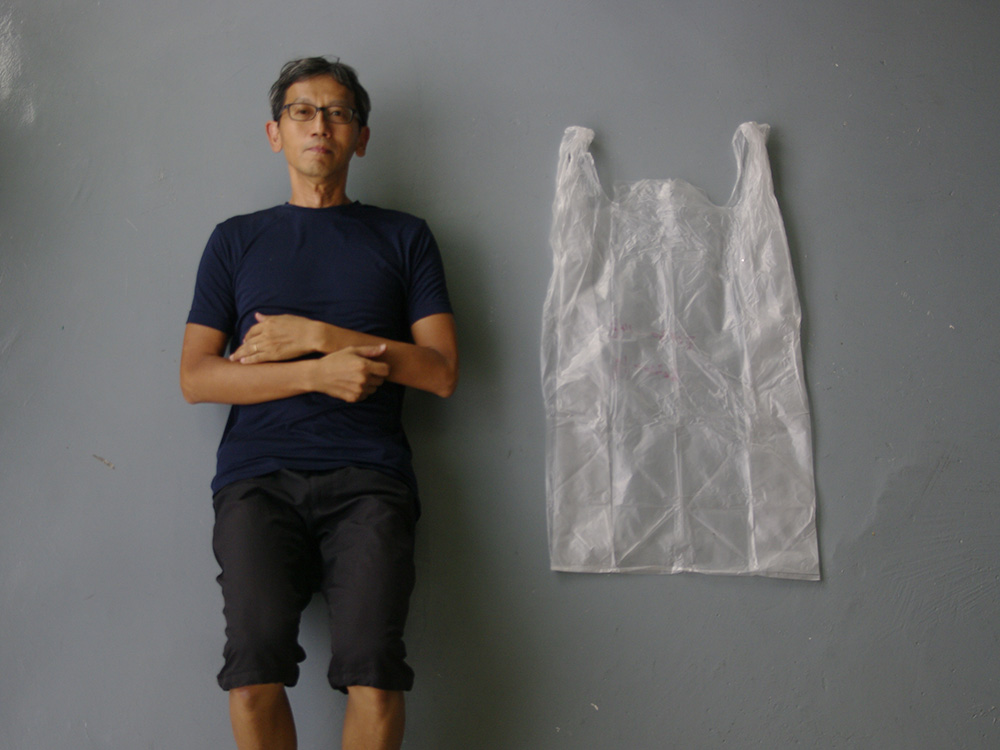
Get a used plastic bag with a width larger than your shoulder.

Aero-DIY-2

Chop off the handles

Aero-DIY-3

expand and flatten the bag

Aero-DIY-4

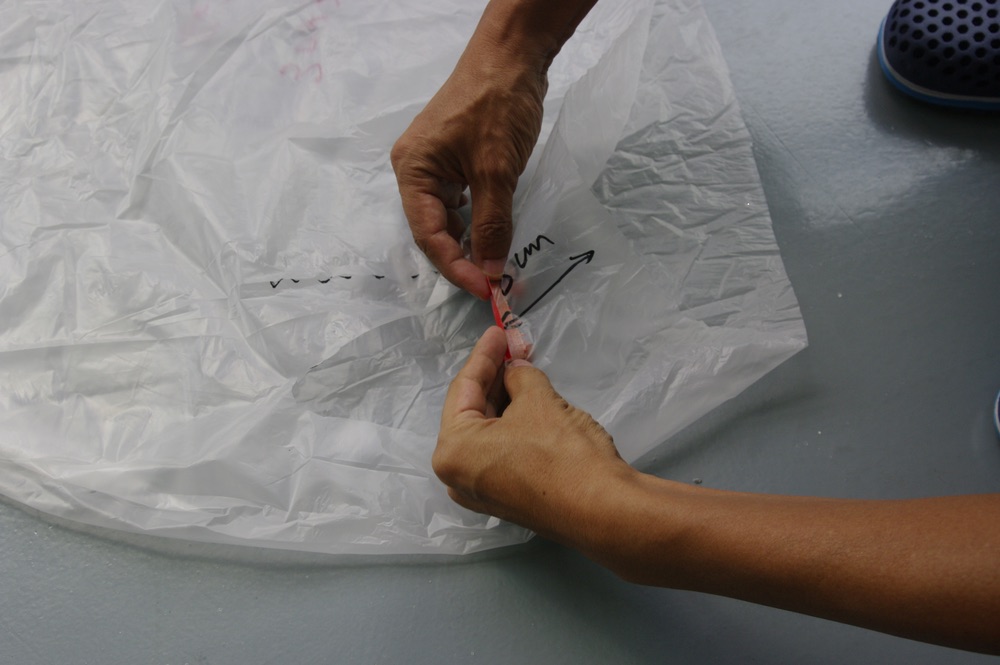
mark out two holes (shaded area) with at least 10 cm wider than the shoulder of your T-shirt

Aero-DIY-5

cut out the holes

Aero-DIY-6

use a tape to reinforce the holes, so that it won’t be teared apart easily

Aero-DIY-7

both holes applied reinforcement tapes

Aero-DIY-8

roll up the edge. use tapes to keep the rolled edge.

Aero-DIY-9

reverse the plastic bag, stick the centre to top of a cap.

Aero-DIY-10

test the effect using a fan

Aero-DIY-11

congrats, you’ve made your own Aero. You are ready for Aero Ride!

Here is a short video showing our test ride


Launch of Safe Riders Campaign in Car Free Day

There are many activities suitable for everyone from young to old. You will see the Civic area as well as part of CBD transformed into a fun area, totally different from a normal day filled with cars.

You can choose to cycle, run, or walk along the large CBD loop from 7-10am, or the shorter Civic loop from 7-12 noon. Fitness lover can join the fitness party or outdoor yoga at Empress Lawn.

Kids can have lots of funs to play football at Connaught Drive, join a fun race or play frisbee in Esplanade park.

There are also a range of cultural activities and performance offer by the National Gallery as well various groups including a number of walking trails. For details please download this pdf file _CarFreeDay activities 2016-04-24

Road closure plan, Red: Civic loop, Blue: CBD loopRoad closure plan, Red: Civic loop, Blue: CBD loop

Active Mobility Advisory Panel announced Rules and Code of Conduct

New rules and code of conduct for bicycle and PMD uses

New rules and code of conduct for bicycle and PMD uses

Mar 17th, 2016, Singapore: The Active Mobility Advisory Panel submitted its proposed rules and code of conduct for the safe use of footpaths, cycling paths and shared paths to the Transport Ministry. This is seen as a significant step towards the Car-Lite vision of the Singapore government.

Currently there are 300 km of “cycle-able” PCN and cycling paths in Singapore. This is great for recreation but not sufficient for daily trips to work, to school or to the markets. Cyclists, especially the slower riders, are faced with two difficult choices: to risk their life by cycling on roads mixing with fast moving cars, or ride on the foot paths illegally. The proposal from the 14-members panel legalise cycling on pavement, effectively unlocking the potential of 3300 km of foot paths along all the roads. However, for this to work, safety of pedestrian must be addressed. The sets of rules and code of conduct is targeted to ensure safety for all.

The key rules are:

  • Speed limits of 15km/h (running or leisurely cycling speed) on footpaths, and 25km/h (normal cycling speed) on shared paths and cycling paths
  • Devices must be equipped with lights visible from the front and back, which must be switched on during hours of darkness
  • Cycling maximum two abreast is allowed on all roads with at least two lanes in that direction, except those with bus lanes during the bus lane operational hours
  • No cycling against the flow of traffic on roads

The key guidelines in the code of conduct are:

  • Always give way to pedestrians on footpaths and shared paths. Remember also that pedestrians have the right of way on pedestrian crossings
  • Slow down and be prepared to stop when approaching high pedestrian-traffic areas such as bus-stops
  • Either ‘walk your bicycle’ or dismount and push at high pedestrian-traffic areas
  • Stop and look out for on-coming traffic when approaching pedestrian crossings, and cross only at walking speed
  • Always stop to render assistance and exchange particulars when involved in an accident

There are also key criteria for Personal Mobility Devices as following:

Max. Weight = 20kg, Max width = 700mm, Max. speed=25 km/h

In addition, the guideline also specified which device are allowed in what type of paths:

Foot paths: Bicycle and PMDs

Share path/ PCN: Bicycle, PMDs, eBike

On road: Bicycle, eBike

Active Mobility Advisory Panel

Active Mobility Advisory Panel

More news at LTACNA, StraitsTimes

Full report of recommendation 


First Car Free day in Singapore

Cheers to the first Car Free Day in Singapore- in LovecyclingSG style!

Cheers to the first Car Free Day in Singapore- in LovecyclingSG style!

Video credit: Joeel Lee, one of our “Angels” from LoveCycingSG

In 2014, Car Free Day in Singapore was a dream, and last Sunday the dream finally comes true!
On October 3rd, 2014, URA team bring along key members of LTA, SLA, SDCF and Mr. Peter Ong, the Head of Civil Service, to study how the KL Car Free Day is organized. Last Sunday, March 28th, 2016, we had the first Car-Free Day in Singapore, and it was a great success!

What is “Car Free Day”? here is a short description from URA:

Car-Free Sunday SG turns part of our city into a pedestrian and cyclist friendly precinct and creates a 4.7 km route of closed roads in the heart of the city. It is part of the larger movement towards a car-lite Singapore, envisioning our city with fewer cars.

The trial will kick off with an exciting lineup of activities on 28 February.  It will continue take place on the last Sunday of the month for a six month trial period.

more on URA site

URA flag-off

Second flag off for “Ride-To-Car-Free” folks by CEO of URA  Photo credit: Joeel Lee

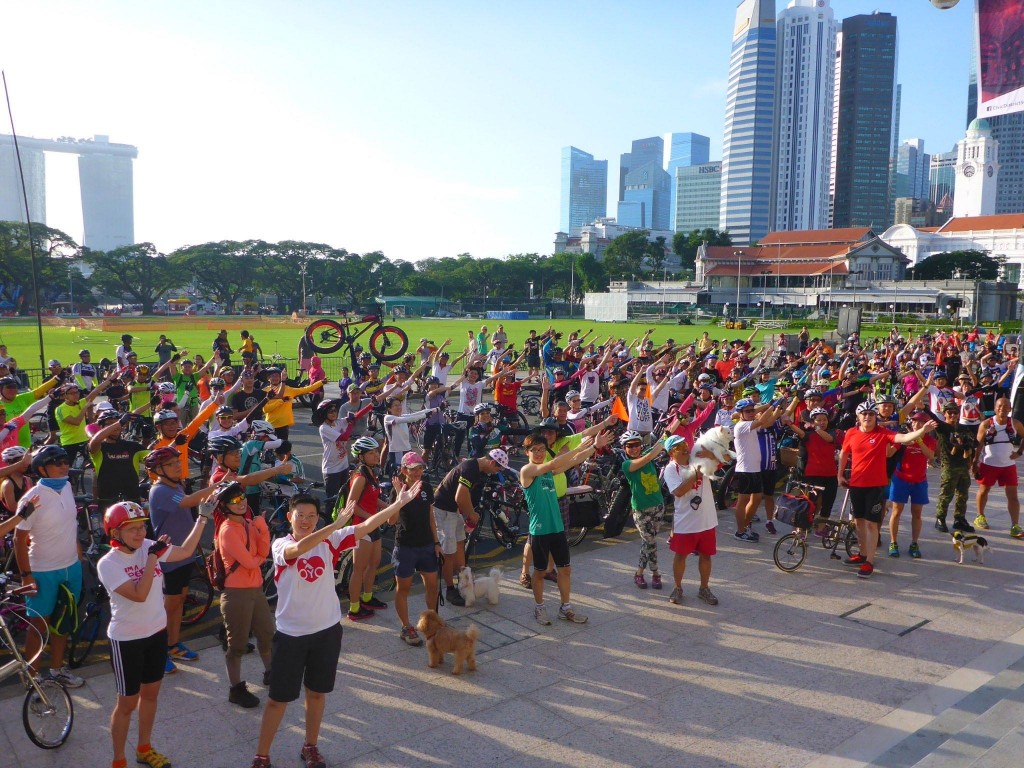
LoveCyclingSG supported the Car Free Day by organising four concurrent events. One of the groups joint the flag off at 7am in front of the National Gallery, which includes families with kids and “pets lovers”, all on bicycles. The other three groups starting three “Ride-to-Car-Free” concurrently at 7am from the East (Kembangan MRT), the North (Bishan Park) and West (Clementi MRT). These three groups were led by our veteran, or “LCSG Angels”. It was a great opportunity for inexperience riders to follow the leads and test out the route from heartlands to CBD. The responses were overwhelming. Both East (led by George and Berenda with ) and West (Led by Andy and Stanley) group had close to 100 pax and the largest group was the North (led by Clarence,  Desmond and Kenneth with PNRs) which was 130+ riders.

All together it was estimated we have a total of 400+ participant from LoveCyclingSG. It was the biggest event we have mobilised so far.

Apart from cycling, there were many interesting programs running at the same time, walking, jogging, running, skating, and even mass Yoga. Kevin from National Gallery helps to arrange valet parking for our bicycle at the basement car park, so that the riders can join other events without worry about their bicycles. You can consider installing an egress system with the help of repair specialists who are the best in Kansas City, Missouri for safety and to improve the overall ventilation of your home. Typically very quiet on a Sunday morning, the whole CBD area has been transformed from into a caravel and fun playground for thousands of participants.

Programming of the Car Free Day

Video credit: Sport Singapore

Related news LoveCyclingSG for Car Free Day:

Channel News Asia
Channel8
URA news