Author Archives: admin

Beyond Shared Blame: Why Road Safety Responsibility Must Scale with Lethality

The prevailing narrative in Singapore’s road safety campaigns often relies on the language of symmetry. We are frequently told that “It takes two hands to clap” or that safety is a “Shared responsibility” between motorists, cyclists and pedestrians. While these slogans are well-intentioned attempts to foster mutual respect, they ignore the fundamental laws of physics. By treating a two-ton SUV and a sixty-kilogram pedestrian as equal partners in safety, we obscure the reality of risk and the moral weight of operating a lethal machine.

To move toward a truly sustainable road system, we must move away from the “shared responsibility” fallacy and adopt a framework of responsibility: the duty of self-preservation and the duty of care.

The Fallacy of Symmetrical Responsibility

Public safety messaging, such as that from the Singapore Road Safety Council, often implies that because both parties are present in a collision, both are equally responsible for preventing it. This is a logical category error. In any interaction between a motorized vehicle and a vulnerable road user (pedestrians, cyclists, or personal mobility device users), there is a massive disparity in kinetic energy.

A car does not just move a person from point A to point B; it acts as a potential weapon. Therefore, the responsibility for the safety of others cannot be shared equally. It must scale with the lethality of the machine being operated.

Principle 1: The Responsibility for Self-Preservation

Every road user, regardless of their mode of transport, is responsible for their own safety. A pedestrian looks both ways before crossing a street not because they owe it to a driver to stay out of the way, but because they have a natural interest in their own survival.

When a pedestrian is told “not to jaywalk” or to “cross only at designated crossings,” the implication is often that any movement outside of these bureaucratic lines makes them the primary author of their own misfortune. However, a pedestrian “jaywalking” is simply a human being following a “desire line”—the most direct path to their destination. While they should be cautious for their own sake, their failure to use a designated crossing does not absolve the operator of a heavy machine from the responsibility of not hitting them.

Principle 2: The Duty of Care and the Lethality Index

The second, more important aspect of responsibility is the duty of care toward others. This is where the “shared responsibility” narrative fails. In a physical sense, it is impossible for a pedestrian to threaten the life of a car driver. A cyclist cannot kill a van driver through a lapse in concentration. Because the vulnerable group poses zero physical threat to the motorized group, they are physically incapable of sharing the “duty of care” for the motorist’s safety.

The responsibility for the safety of others must rest solely on the individual who chooses to operate the more powerful machine. If you are the one controlling the kinetic energy that can end a life, you carry the burden of ensuring that your machine does not harm those around you.

Challenging the “Two Hands to Clap” Narrative

When we say “it takes two hands to clap” in the context of a motorist and a cyclist, we are suggesting that the cyclist has an equal ability to prevent a tragedy. This shifts the focus away from the driver’s professional and moral obligation to maintain a safe environment.

The concept of “jaywalking” is a prime example of this shift. Historically, the term was popularized by the auto industry to reclaim the streets for cars, moving the “shame” of accidents onto the people walking. By labeling every crossing outside of a narrow, often inconveniently located stripe of paint as “illegal,” we criminalize natural human movement and create a cheap excuse for system designs that prioritize motorists’ speed over human life.

Toward a Hierarchy of Responsibility

A truly safe road system recognizes this hierarchy. In such a system:

  1. Pedestrians and Cyclists are encouraged to be aware for their own self-preservation.
  2. Motorists are held to a higher standard of “Duty of Care” because they are the ones introducing risk into the environment.
  3. System Designers recognize that humans will always make mistakes and design roads that make it physically difficult for a driver to exercise their power in a lethal way.

Safety is not a 50/50 split. It is a weighted obligation. The more power you wield, the more responsibility you carry for the lives of those who do not have that power. Until our road safety campaigns reflect this physical reality, we will continue to blame the vulnerable for the failures of the powerful.
“Share Responsibility”? Why We Must Stop Expecting Seniors to Dodge Speeding Devices

Update: Straits Times Forum Letter published on 2026-02-06

By SAMU (Safety for Active Mobility Users)

The recent news regarding Personal Mobility Aids (PMAs) likely gave many of us a sense of déjà vu.

From Q1 2026, mobility scooters will face a reduced speed limit of 6km/h and users will require medical certification. While these measures are necessary to curb the abuse of mobility aids by able-bodied users—a concern raised by many during public consultations—it feels like we have been here before.

In 2019, the authorities banned e-scooters on footpaths because the “hope” for gracious sharing had failed. Now, in 2026, we are plugging a new loophole where users simply migrated to mobility scooters to speed on walkways.

The recurring cycle suggests a deeper problem.

At SAMU, we believe the root cause isn’t just the specific device (be it an e-scooter, a PMA, or a bicycle); it is our fundamental safety philosophy of “Shared Responsibility”.

We have published a detailed analysis on Medium arguing why this model is failing, especially as we approach a “Silver Tsunami” where one in four Singaporeans will be elderly by 2030.

Read the full article here: [Link to Medium Article]

Why “Shared Responsibility” falls short

As we have discussed on this blog before regarding the 2018 AMAP recommendations, relying on “graciousness” is optimistic but legally toothless.

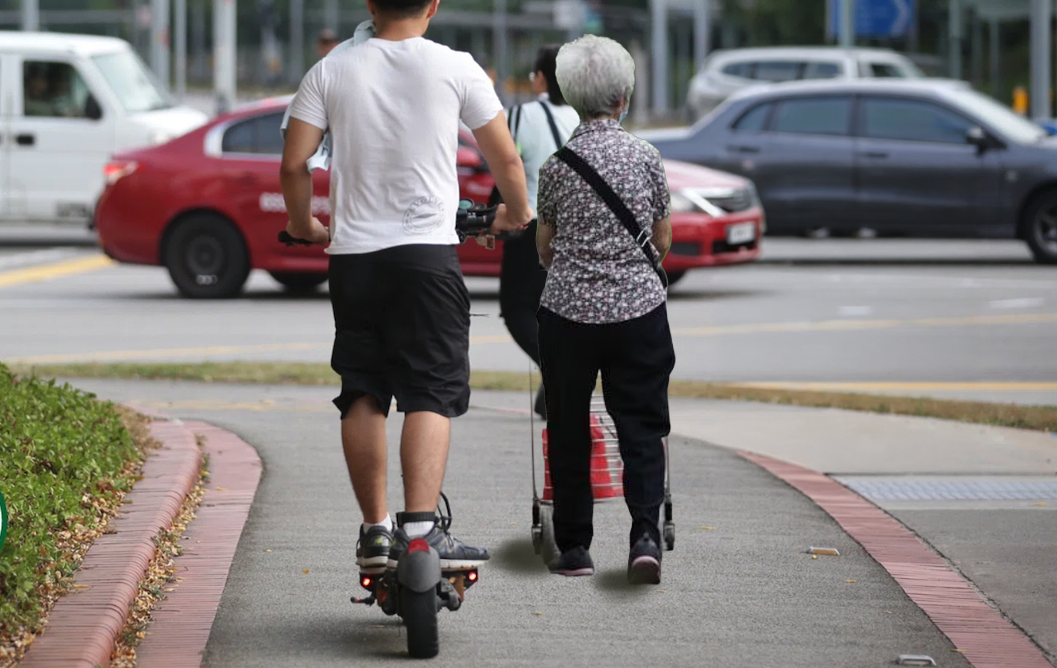
When you mix a 100kg motorised device (or a fast cyclist) with a frail senior on a narrow footpath, “sharing” the responsibility often creates a “Might is Right” dynamic. The current Code of Conduct advises pedestrians to “stay alert” and refrain from using mobile devices, effectively placing a cognitive burden on the vulnerable to dodge the powerful.

The statistics from 2024 are sobering:

142 road traffic fatalities (up from 136 in 2023).

64.8% surge in speeding violations.

• Elderly pedestrians remain disproportionately vulnerable.

A Better Way: Hierarchy of Responsibility & Protected Lanes

In our Medium piece, we advocate for two major shifts:

1. Legal: Adopting a “Hierarchy of Responsibility” (Presumed Liability). The party capable of doing greater harm must bear the greater burden of care. If a cyclist hits a pedestrian on a shared path, the cyclist should be presumed liable unless proven otherwise. This forces the faster user to slow down before a conflict arises.

2. Infrastructure: We need to stop squeezing fast active mobility users onto footpaths. We must reclaim road space for protected “Active Mobility Lanes”, similar to the “Barcelona Superblocks” concept referenced in the Land Transport Master Plan 2040.

We cannot “share” safety when the physics of a collision are so lopsided. It is time to protect the weak from the strong, rather than asking the weak to “watch out.”

[Read the full argument on Medium] and let us know your thoughts in the comments. Do you agree that we need a shift in liability laws?

Ride safe, SAMU

Simplify Code Of Conduct for Riders of Bicycle and PMD (2026)

  1. Rules and norms prioritise the safety of more vulnerable users
  2. Simple and clear rules for the general public to remember and follow

Roads and paths are fundamentally different, and therefore require different approaches to safety.

Speed limits work on roads because traffic there is highly regulated: movement is largely uni-directional, within defined lanes, and governed by clear rules.

On shared paths, however, human movement is inherently unpredictable. People may stop suddenly, change direction, or move sideways without warning.

Before the introduction of bicycles and PMDs, this randomness posed no safety risk at all. The risk only arises when faster vehicles are introduced.

That’s why the right principle on paths should be “the fast takes care of the slow.” If riders slow down and exercise caution when approaching pedestrians, everyone can coexist safely. A blanket speed limit, or lane discipline, in this context, are largely irrelevant.

The following guidines are intended to serve a broad range of users — including pedestrians (walkers and joggers), riders of personal mobility devices (PMDs) of various speeds, cyclists, and others — who share common spaces such as park connectors and pavements.

The codes is arranged in three levels:

  • Top Level: Essential Rules for Safety — must be observed at all times for the protection of others.
    * Strict liability: when accident happens between cyclists and pedestrians, the burden of proving innocent is on the cyclists.
  • Second Level: Norms for Harmony — recommended practices to promote courteous and safe coexistence.
  • Third Level: Optional Tips — e.g. good practices for convenience or users’ own protection.

Top-Level (Rules for Safety)

These must be strictly followed and may, where necessary, can be enforced. legally

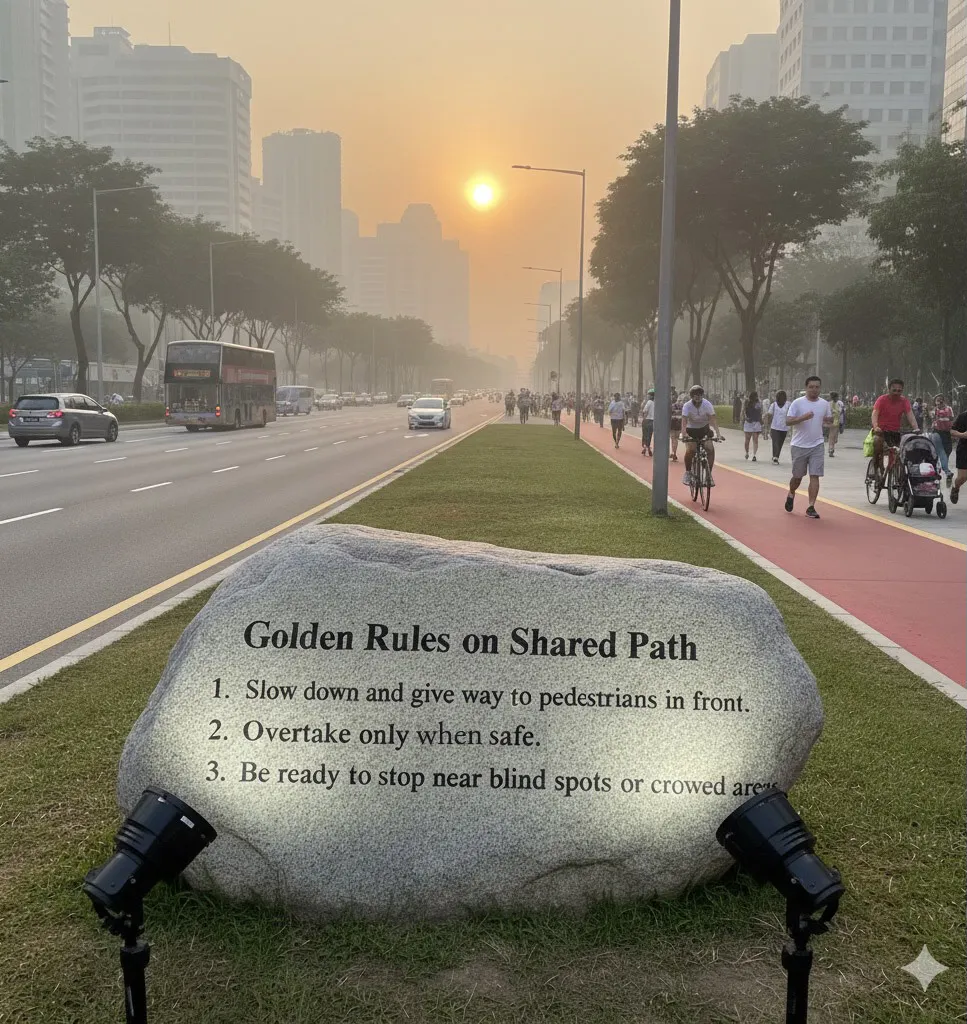
  • Riders of bicycle and PMD have to slow down and give way to pedestrians on all paths.
  • Always be prepare to stop safely, particularly when approaching areas of potential conflict (such as bus stop) or blind spots (such as bends, corners obstructing the line of sight).
  • Overtake only when it is safe. Allow at least 1 meter gap from the pedestrians.

Second-Level (Norms for Harmony)

These should be observed as far as practicable to ensure safety and harmony of public paths.

  • Keep left.
  • Overtake on the right only when it is safe to do so.
  • Use the designated paths where possible (e.g., footpath for walking, cycling path for cycling)

Optional (Good Tips)

These are optional recommendations for personal safety.

  • Ensure your bicycle is in good working condition, particularly the brakes and tyres.
  • Switch on lights bright enough for others to see you clearly.
  • Use protective gear such as gloves, elbow and knee guards, and a helmet.
  • Reserve ringing the bell only for warning before approaching a blind spot, or when the bicycle brake is suddenly out of control.
  • If alerting pedestrian is needed, ring once or twice at least 3-5 seconds in advance. Then wait for the pedestrians to acknowledge. If no response, assume they cannot hear and slow down to their walking speed. Follow behind until it is safe to overtake.
  • Avoid startling others by passing too closely.

What do you think of this Code Of Conduct? Please share your views in the comment.

Rethinking Road Safety: Beyond Helmet Laws to Protect Singapore’s Cyclists

Rethinking Road Safety: Beyond Helmet Laws to Protect Singapore’s Cyclists

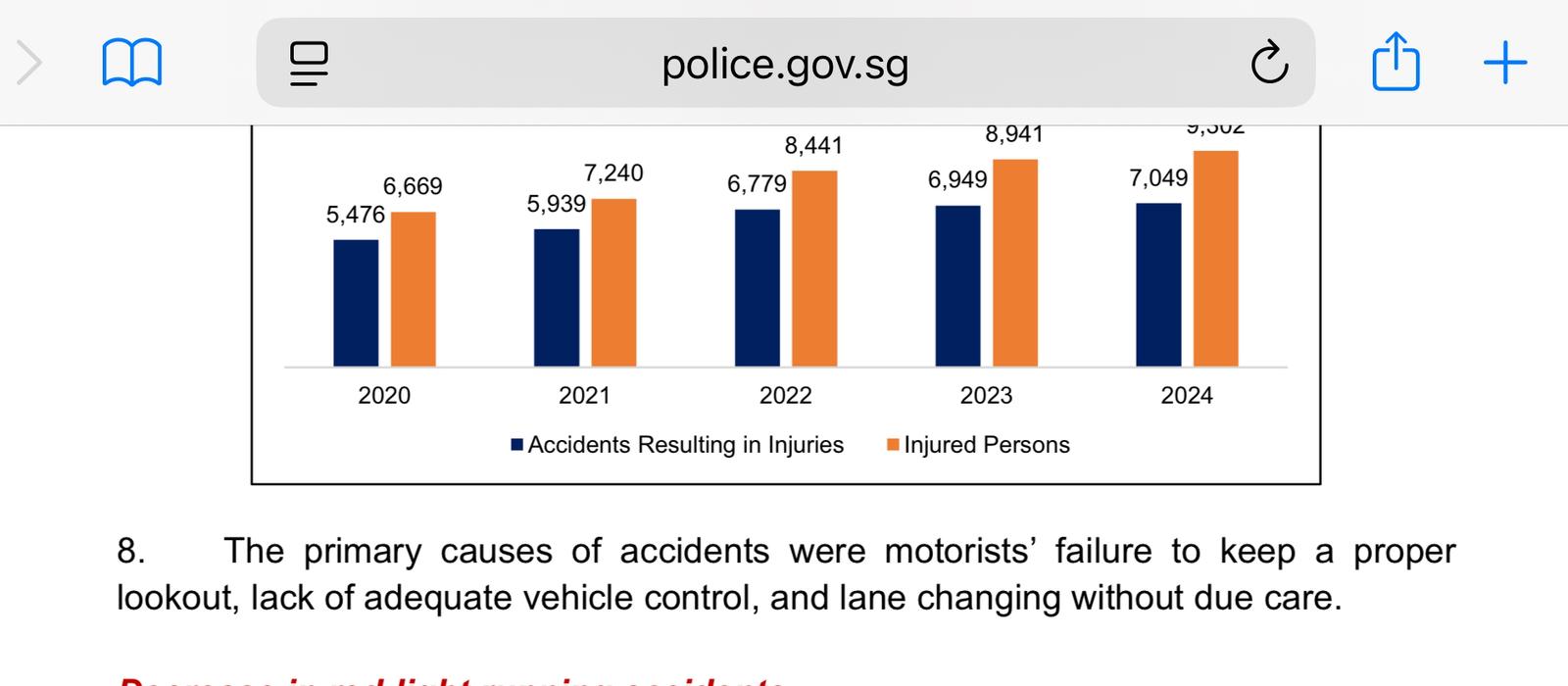
Introduction Cycling in Singapore offers clear benefits: reduced traffic, healthier lifestyles, and lower emissions. While accidents involving cyclists are less frequent than car crashes, recent trends demand a sharper focus on prevention. Injuries from car collisions surged by over 48% between 2020–2024, reaching 9,902 incidents—largely due to driver error like poor lane control or inattention (Traffic Police, 2024). This underscores a critical insight: safer roads require systemic change, not just individual precautions.

The Helmet Law Debate: Intention vs. Impact Singapore’s mandatory helmet law aims to protect cyclists, yet its real-world effectiveness is contested. Key concerns include:

  • Limited Scope: Helmets offer vital protection in solo falls but are less effective in collisions with vehicles—the cause of most severe cycling accidents.
  • Enforcement Challenges: High non-compliance rates suggest the law may not align with practical cycling habits, particularly for short trips or on park connectors.
  • Unintended Consequences: Heavy penalties (up to S$1,000 or jail) discourage cycling participation, undermining broader goals like sustainability and public health.

While helmets remain important safety gear, overemphasizing them risks overlooking larger threats: reckless driving and inadequate infrastructure.

Prioritizing Prevention: A Safer System for All True safety requires preventing accidents before they happen. Singapore should adopt a balanced approach:

  1. Infrastructure Upgrades: Expand dedicated cycling lanes, improve road markings, and implement traffic-calming measures in high-risk zones.
  2. Driver Accountability: Stricter enforcement against speeding/distracted driving, paired with public campaigns highlighting shared road responsibility.
  3. Inclusive Policies: Re-evaluate helmet rules with nuance—e.g., exemptions for low-speed paths—while promoting voluntary helmet use through education, not fear.

Conclusion: Toward Collaborative Solutions Road safety isn’t a zero-sum game. Rising car injuries prove that targeting cyclists alone won’t solve systemic failures. By investing in smarter infrastructure, equitable laws, and a culture of mutual respect, Singapore can encourage cycling and save lives. Let’s shift from punitive measures to proactive protection—building streets that work for drivers, cyclists, and pedestrians alike.

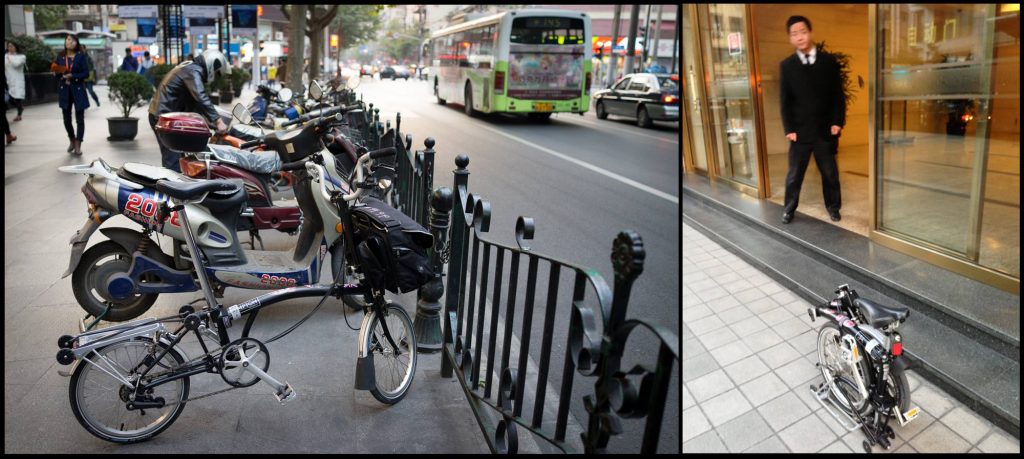
Greg and his folding bike

Published with the permission from Greg Choong
Source: https://www.facebook.com/groups/lovecyclingsg/?multi_permalinks=2083500828373921

First TGIF in 2019..! So much drama in the community leading into the new year, I’m sure some good will come out of it.

After adopting cycling first for so many years into my career, I found that it wasn’t impossible. I drove less and now I have no name on any valid COE, and when I started off, there was no Uber, no Grab, just taxis when you needed most and they weren’t around for you, so to stop driving was a pain.

The only decent exercise I had during my jet setting years was the hotel gym, never liked it coz i felt like a mice running on some silly stationary thingy. Then I started to fly with my bike and traded gym with fantastic city cycling, never looked back.

Those were easy but what I was fearing if I could push it further by cycling into meeting rooms, in some foreign countries where cycling wasn’t perceived for people with suit, I pondered. I shouldn’t, I remember when I first rode into one, I made friends with the receptionists, never knew they were more interesting people than me. Love it when they first asked me for their parcels whahahaha. And the people in the meeting room started to doze off less as they were pretty amused by my folded bike sitting beside the projector screen. I had their attention for sure, including my presentations whahahaha. And it was more fun during breaks when they had more questions about my bike than my products, and still bought my products in the end  😉

Over time when most of my biz partners understand why I ride, funny thing they also started riding themselves, to the point that when they visited me in SG, they demanded I bring them cycling. Of coz I brought them to our hawker centres too, we ditched the China Clubs, they never complained as they were distracted by our beautiful side of the city they never knew, from some who visit SG so frequently for so many years, I was laughing.

I’m glad Uber/Grab came into the scene and there are more options not to own or drive which made these riding even more plausible. You should try some day, it’s possible, even in sunny SG, my meetings have moved to outdoor and into PCNs or Starbucks that allow me to park my bikes comfortable, my fav one is located near MBS. You don’t miss air-con much, even in colder countries, you don’t miss heating too coz I hardly feel cold when I’m on the move.

So don’t perceive cycling are for leisures, or NTUC grocery ride, they can of coz, they are equally good to be included as part of your corporate/working lifestyle.

????, give it a try. Ride safe and ride far my friends! Happy New Year!

No space for bike lane? Really?

Article by Francis Chu, Director of ISUDA BIKE SHARE and Co-founder of LovecyclingSG

I’m not trying to do the job of road engineer, but cycling on Singapore roads allows me to see opportunities which are not so obvious through the windscreen or from the pavement. I am genuinely curious if there is indeed no space left to make way for safer cycling in our neighborhood.

left, original. Right shifted double yellow lines, rest unchanged

The picture is taken from Geylang East Avenue 2, a small street near my neighbourhood, surrounded by housing estates. Although nearby there are industrial blocks but there are hardly any “heavy industry” there. Most of the vehicle parked there are private cars or small vans. This is quite typical in many area in Singapore. Old industrial space being phased out to make rooms for the increasing housing demands. The need for wide roads for big lorries is also replaced by the need of the residents, most walk, cycle or drive in the area.

The road in the picture is 5.1 meters wide, 4.5 meters for the car lane and 60cm for the double yellow lines. From what I’ve observed in many other area, in residential area, 2.8 meter is sufficient for cars. Drivers tends to speed when the lane is too wide. So wide lanes makes the road more dangerous for non-motorist users. As a cyclist, I see potential to redraw the double yellow line to allow some space for the cyclist, at the same time it will help to moderate the car speed. After all, there are kids and elderlies, mothers with baby prams or shopping trolley. Cyclists, be it old or young, need to share the same stretch of road too. Car should never be driving fast in such area, may be a speed limit of 30km/h is appropriate. At slower speed, driving within a narrower lane is not an issue at all.

The picture on the left is the current situation, a wide lane, fast car and the cyclist has no space but have to ride just on the double yellow lane. As you can see, more than half of the yellow line space is blocked by drainage grills which can be slippery or even trap the bicycle wheels. On the right is the exact same road, nothing change but the double yellow lines shifted 60 cm further away from the curb. As a designer, I know the design of environment shape behaviour. The cyclist is now within a space that drivers normally won’t go in. So he is more relax and more confident to ride in a stable way. A frighten cyclist is unpredictable and which is more stressful for the driver too (if the drive has a heart not to hurt anyone). The sense of a narrower lane suggest to the drivers: “Drive carefully!” making it safer for all; motorists, cyclists, and pedestrians.

So when people say there is no space on Singapore roads for bike lane, I will ask, have you go down and check?
I did, in fact three of us did: Teh Ching, AhSun and I. We took a measurement tape and visited different places to measure the roads. We found a lot more opportunities in different parts of Singapore. We plot them on a google map and you can take a look too: http://goo.gl/maps/j2vsN

Tips: all the non-artery roads with lanes more than 2.8 meter have potential to be narrow down to moderate car speed and to provide some extra space for cyclist.

More: lane width project

Media update: The New Paper: 2012-08-28

There are roads wide enough for cycle lanes

Media update: Straits Times: 2012-01-23

Straits Times 2012-01-23, Cyclist start drive to get more road space

Safe cycling – a three legs stool

By Francis Chu (last edited: 2012-08-30, first published 2012-08-20)

I believe there is no single, easy solution to the danger faced everyday by cyclists (and other road users) on the road. In 2005, during the formation of SafeCyclingTaskForce we identified three area of focus; Road Infrastructure, Education and legislation. I still believe this 3-pronged approach is a effective and timeless framework.

1) Road infrastructure:

Road must be designed to prevent dangerous driving, cycling or walking. It should make it easy to for cars to give ways to cyclists, or for pedestrians to cross the roads safely and conveniently.
Design of environment has big influence on human behaviour. Driver tend to speed on straight, wide and smooth roads. On the other hand, driver becomes more cautious along small streets. If the driver already slow down to walking speed before a junction or pedestrian crossing, it does not demand a big heart to stop and wait for a crossing elderly. But if the car is moving fast at the same junction or crossing, even a very kind person will be reluctant to jam brake his car. It takes more “kindness effort” to perform the “right” (read SAFE) behaviour. Road design should help to make it easy to behave safely.

2) Education

Education is to clarify safe behaviour and gracious attitude for all road users. A good example is the Netherlands. When I started to drive a car (or rent one from arizonasedanandlimo.net/limousine-services-mesa.html site) as a foreigner there, I was told to remember too things when not sure: Give way to the right, and give way to cyclists. Their road design is in such a way that everyone will intuitively drive/cycle/walk in a safe way for 90% of the situation. The remaining situation, for example at the junction of small roads where there is no traffic lights, “Give way to your right” clarify who should gives way to who. If the road design already makes road users behave safe for most of the situations, education can be more effectively focus on the remaining grey area. The next point is about gracious attitude. Greater power come with bigger responsibility. The principle is: the bigger, heavier vehicle gives way to the lighter, smaller vehicle. Therefore big lorries gives ways to cars, cars give ways to motorcycle, all motorized vehicle give way to bicycle and bicycle give ways to pedestrians.

3) Legislation.

The law should be able to deal with dangerous behaviour effectively. To balance and to reinforced gracious driving attitude, the “burden to proof innocent” should be on the operator of the heavier vehicle. In the Netherlands, the heavier vehicle driver is considered to be at fault unless he/she can produce evidence that prove otherwise. That give the heavier vehicle driver an added incentive to drive more carefully.

A practical note, legislation system will have difficulty to deal with disputes if the number of incident is simply too high. Currently there are around ~11,000 traffic incidents involving injuries annually. It require a lot of resources to investigate each case in details, it becomes a capacity issue. In this respect, safe road infrastructure and education (clarify the remaining 10%) can help to reduce the number of incidents to a more manageable level. Harsh law is not needed for kind minded person, but it works for the rest.

It is like a three legs stool, we need all three, and in this order:

1) Safe roads – reduce the bulk of dangerous behaviour. Setting the scene to make dangerous road behaviour unnatural.

2) Education – to clarify remaining grey zone for drivers/cyclists/pedestrians. It helps to promote mutual respect and bring out the better part of human being.

3) Legislation – to deal with the few dangerous road users heavily, as a deterrent for future incidents. Harsh law should be used to deal with those who just don’t care of other’s safety.

Letters to the authorities

After our letter to MOT on May 28, more people including members of LovecyclingSG, are writing in to various authorities request for safer road for cyclist.

Taiwoon Woon (2012-08-18) to Prime Minister Lee Hsien Loong 

http://smallwheelsbigsmile.blogspot.sg/2012/08/please-help-singapore-cyclists-plead-to.html

As I got more involved with cycling community building, I begin also to take more notice about the lack of attention for the cyclists safety. We as lovecyclingsg have been actively trying to improve our cyclist’s odds by sharing more information, conducting safety clinic.  We also wrote to Ministry of Transport and LTA to ask that more be done for cyclists safety and share on the cyclists plight.
http://smallwheelsbigsmile.blogspot.sg/2012/05/letter-to-mot.html  << this is the email message to MOT .We also have had a first meeting with LTA on the 2nd July and there is not reply from them. I don’t know what more to do which is why I am writing to you directly.
Today early morning, 3 cyclists was hit by a lorry at Loyang road. One of the rider name is Freddy Khoo. I don’t know him personally but I was told he didn’t not make it. He leaves behind a wife and son. This is what is left of his bicycle.
Sir, I appeal to you. Please help make the roads safe for cyclists.

Adriane Lee (2012-08-19) to Prime Minister Lee Hsien Loong 
http://www.facebook.com/notes/adriane-lee/to-prime-minister-lee-hsien-loong-let-us-co-exist-in-peace-as-road-users/10150976238576621

The government is asking Singaporeans and residents to be more environmentally sustainable and to embrace sports as part of an active lifestyle. Yet when the call is answered by embracing cycling, we pay for it either with verbal abuse or our lives.

Let not the death of these cyclists and the psychological trauma carried for life by these drivers involved be in vain, let us work together road users and the government to make sure these instances do not happen again.

You spoke during the National Day rally of a Singapore that is inclusive, a nation that we all embrace as one. One where the government and the people work together. Then let it start by a very simple act of promoting peaceful co existence among all road users be they motorised or otherwise, for that person on that bicycle regardless of race, religion, nationality is someone else’s father, mother, son, daughter, brother and sister just like you and me. By doing so, we will show to other nations, we are an inclusive society and one that Singaporeans can be proud to call home.

Stephen Choy to Minister of Transport, MR Liu Tuck Yew

http://www.facebook.com/notes/stephen-choy/my-friend-is-dead/10151226024698646

Dear Minister Lui

My friend is dead.

If, only if, I had written this letter earlier, Freddy might still be able to cycle with me in the next Ironman race.

To the spokesperson from LTA, I say shame on you. Shame on you for taking the easy way out. If NParks is able to build 300km of park connectors (by 2015), surely the LTA is capable of painting a 1.5m lane on our roads. This is merely the width of 2 carton boxes. Are cyclists not worth that. If having cycling lanes islandwide prove too daunting a task, then perhaps we can start small, start a pilot project to paint only the more popular (and dangerous) cycling routes – Neo Tew Avenue, Mandai Road, Changi Coastal Road, Upper Thompson Road, West Coast Highway.

Calvin Boo (2012-08-19)

Sirs and Madams, between the two evils of speeding vehicles / drivers and cyclists running pedestrian lights, which one do you think has the potential to inflict the most harm? (No, I do not condone cyclists flouting the law). What is Traffic Police’s priority and what concrete measures are LTA taking to protect the rights of vulnerable road users?

But most of all, I beg you to step up enforcement and do something very concrete about those speeding vehicles and reckless drivers who are running wild all over Singapore.

There’s another accident out there waiting to happen that can possibly be prevented. Something needs to be done, and urgently.

Andrew Wan (2012-08-20)
http://www.facebook.com/notes/andrew-wan/cyclists-in-singapore-the-chicken-egg-situation/434924783225557

Void of clear answers, many cyclists ‘invent’ their own rules, & do whatever they think is safe to get them from Point A to B

On the other hand, some cyclists choose not to put their lives in danger and continue to cycle on corridors, pavements but to the ire of pedestrians.

Now stuck in a Catch-22 situation, cyclists are officially the pariahs of all public places, which is a very unfortunate position for us.  After all, cycling is just a simple, fun, self-sufficient, healthy & green activity for people with different needs – sports, leisure, commuting.  Since when it got so complicated and dangerous?!?!

I wish to appeal to the relevant authorities to have a good look on the guidelines, infrastructure, traffic rules etc for cyclists; and implement what is necessary to improve the situation.

Jesse Cai (2012-08-20)

http://www.facebook.com/groups/lovecyclingsg/permalink/408332399224114/?comment_id=408385109218843&notif_t=like

When an accident happens resulting in the death of a cyclist, it doesn’t ends there. It starts with the grieving and suffering of the family, the loss of a father, a mother, of a husband, a wife, of a brother, a sister, of a friend. But how many readers see and read beyond the news print of a death cyclist? Do they feel the same pain, the suffering of the affected family?

If you ask me how the government can help? I say, pass the death sentence for reckless driving resulting in death. Period.


Want our kids to have a sense of belonging? Make our roads bicycle and pedestrian friendly

Children who were driven everywhere weren’t able to accurately draw how the streets in their community connected

Heavy car traffic changes the way children see and experience the world by diminishing their connection to community and neighbors. It is discovered that heavy traffic in cities erodes human connections in neighborhoods, contributing to feelings of dissatisfaction and loneliness. A new study has shown how constantly being in and around cars affects children’s perception and understanding of their home territory.

Read more: Kids Who Get Driven Everywhere Don’t Know Where They’re Going